

Can you read poker cards like tarot?
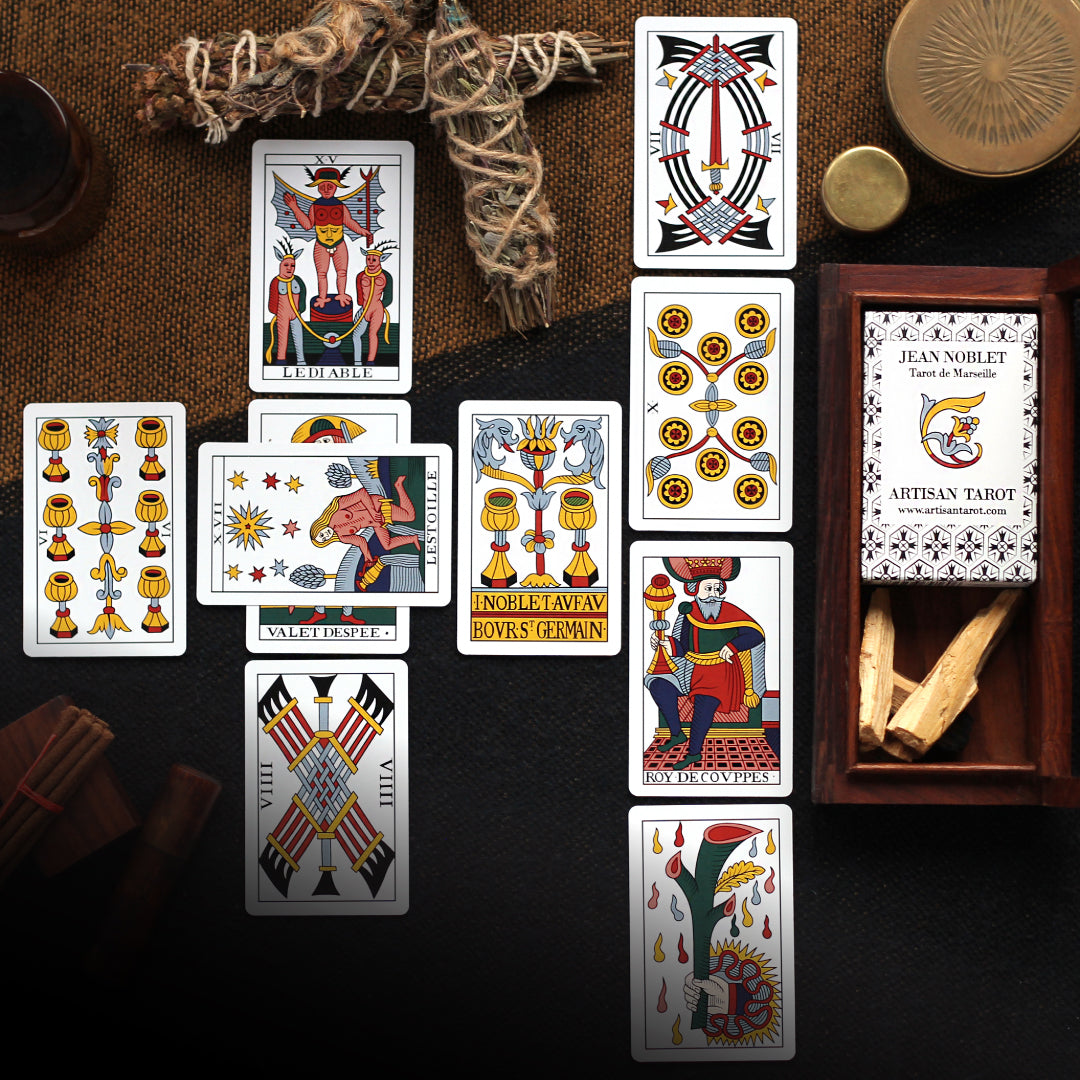
A common question I get is: can you read poker cards the same way you read tarot? The answer is yes, especially if you're familiar with the Tarot de Marseille. And why shouldn't you be? It is literally where we get tarot from. And before it was a divination technique, it was a game, very similar to poker, or more correctly, spades.
So today on the Art of Divination podcast, we'll be discussing the Tarot de Marseille. We'll discuss its origins, its history, and some of the reading methods that make it truly unique even in this modern era. So sit back, relax, and join us as we explore the art of divination.
Why the Rider-Waite-Smith deck took over
Welcome to the Art of Divination Podcast, brought to you by Artisan Tarot. I'm your host, Z. Mann Zilla.
On this episode, we'll be discussing the Tarot de Marseille. Now, I have to confess, this is a topic I bring up a lot with people when I am talking about Tarot. It's usually the one I try to get people to learn first. Of course, even when I'm recommending people learn at first, I understand that I'm starting people off on a bad foot. The reason why is because, well, there's just a way that people understand tarot works nowadays.
Whenever you see tarot cards in pop culture, say movies or TV shows or things of that nature, the cards you always see are what we call the Rider-Waite-Smith deck. These were cards that were originally commissioned by Arthur Waite in the early 1900s and first published in 1909. And they're called the Rider-Waite-Smith cards because they were published by a company called William Rider and Son, commissioned by Arthur Waite, and the artist was Pamela Colman Smith. And it wasn't the first tarot deck specifically produced for divination purposes, but it was the most popular, basically. Although it is also notable as being the first tarot divination deck where the pip cards were fully illustrated, just like the Major Arcanas and the royals.
Prior to this, even divination decks tended to use clusters of symbols to represent the numbers. So, you know, if you had your Five of Swords, it would be a picture of five Swords.
Tarot started as a game
Now, the reason I bring this up is because one of the things that the ubiquity of the Rider-Waite-Smith deck has done is it has made it more difficult for people to understand that Tarot started as a game. In fact, it's really interesting how many times I get the question, hey Zilla, can you read poker cards the same as you can read tarot cards? The answer is yes, because I know how to read tarot de Marseille.
But the reason why I find the question so fascinating is because 100 years of whitewashing Tarot's past by creating all of these cards that you know fully illustrate all of the minors and do all of this stuff to kind of almost cover up those origins to make the cards look less like game cards.
Well, if that wasn't a thing, it would be fairly obvious that you can read poker cards the same as tarot cards, just minus the majors. But it wouldn't be the first and only time that tarot history has been covered up with something just completely outlandish and esoteric to cover up what are actually pretty mundane origins, and let's get into some of them.
Where the name Tarot de Marseille comes from
Let's start with how the cards themselves came to be and what they were used for. Now I'm gonna be correcting a lot of people's understanding of tarot history, so I may as well start with correcting where the term Tarot de Marseille actually comes from. Because while the term itself refers to cards that were produced typically within the 1500s to 1700s, the term itself actually didn't start getting used until about the mid-1800s. And it was a blanket term to describe playing cards that were made in or around the Marseille region in the south of France. And there's really no mystic relevance to any of that. It's just where they made a lot of their cards at the time.
Regulation, taxation, and worn-out decks
Now, because playing card production was such a big part of the Marseille economy at the time, there were also a lot of strict laws governing it. And while on its face, those were to keep the game fair, because obviously you want to make sure that gambling is fair and equitable to everybody involved, really a lot of it had to do with taxation. There was a tightly regulated manufacturing process in place, and in fact, if you look at a lot of old images of the cards of the time, you'll see little tax stamps on them.
Also, these older cards tended to wear out a little quickly, so they'd get a little frayed at the edges or get little folds in them from constant shuffling. It was very easy to mark the cards as a result, so you had to swap the decks out often. This created a large demand for these cards, and so they came up with a printing process that could meet that demand.
Why the art is so simple
The process was to carve wooden blocks with the images in them. And as you can imagine, carving 78 wooden blocks to make a deck is quite an undertaking, so much so that they didn't want to have to repeat the process if they didn't have to. But in order to control the flow of the product and to make sure nobody was making their own counterfeit cards, they used to keep these blocks securely locked up at night.
That said, if one of these companies got sold, then the new owner would take on those valuable blocks, but they would also tend to scrape off the makers' marks of the previous owners just so that they could add their own. So another thing you'll see in a lot of older cards is places where the makers' marks are just a little messed up or something to that effect. That would be why.
But getting to the actual point I'm trying to make here, the reason why the art in Tarot de Marseille decks is so simplistic is because they come from wood carvings.
The game, and how the deck is built
All of this, so thousands of people could play a game called Tarot. And you know what? I've actually played the game. It's nowadays we call it French Tarot. There's actually video games that play it as well if you're interested in trying it out risk-free and without the gambling aspect. In essence, it's a trick-taking game. If you've ever played spades, it's a little like that, but with a fifth suit and a bit more complicated. The scoring I could not even begin to summarize. What I would say is if you want to try it out, definitely bring a calculator and at least two copies of the rules, just so the inevitable arguments can be made quicker.
But if you look at a deck of tarot cards, you will notice that what we now call the Minor Arcana, or what are typically also called the pips, you'll see that there's an ace through ten section of each of the four suits. You'll see that there are royals, although in a tarot deck they have four royals instead of the three we know about in poker, but still very similar. And this structure was itself based on some Italian games. The one in particular that sort of predates tarot and which the decks most closely resemble one another is an Italian game called Tarocchi.
When did the cards become divination?
Now, these are the facts that we can confirm, historically speaking, but that does beg the question: at what point did they become associated with the divination arts? When did people start fortune telling with them? And that one's a little harder to pin down. There are references as early as the mid-1400s talking about using cards possibly for divination, but the context also suggests that they might have just been talking about the evils of gambling.
This evidence, of course, coming mostly in the form of religious commentary. There are scattered references hither and yon about the evils of triumphs, but the thing is it's hard to tell from the context if they're specifically saying people are using the cards to tell fortunes or people are using the cards to play gambling games. Both tend to be considered sins in a lot of religious beliefs of the time.
The Egyptian origin myth
No, for the first recorded instances in history of the cards being used for divination and fortune telling, we need to discuss why everybody seems to think it came from Egypt. The first explicitly recorded history of cards being used in fortune telling dates back to the late 1700s. That's gonna start with a Protestant pastor named Antoine Court de Gébelin, who claimed in an essay that tarot decks contained references to an ancient Egyptian text called the Book of Thoth.
Now, recently I was doing some research for a Miss Cleo Tarot Power Deck instructional video watch-along that I did with some of the folks that watch me over on Twitch. This included watching some commercials of other 900 number tarot services that were available in the late 90s and early 2000s, and you would be amazed how many of them referred to Tarot's Egyptian origins.
So if you're wondering where tarot artists throughout history have gotten this idea, they got it from this essay by Antoine Court de Gébelin. And before I reveal to you what his theory was, I want you to keep in mind that all of this predates any sort of European translation of the Egyptian language.
But essentially, this Protestant pastor looks at tarot cards and decides, just based on what he's seeing, that symbolism from it matches up one-to-one with stuff from the Book of Thoth, this ancient Egyptian text. And from here, Court de Gébelin theorizes that the Egyptian priests gave that knowledge to the Romans when those two cultures got together and met.
And then the Romans hung on to that and eventually it made its way into the hands of the popes, and then from the popes, it eventually made its way to France, where they used it to inspire the designs of their cards. And again, as a reminder, Court de Gébelin has no access whatsoever to any translations of the Egyptian language. He has nothing whatsoever to base any of this on.
My own theory, and other borrowed cultures
And so, in that proud tradition, I would like to present my own theory as to where he got this theory. And I'm gonna clarify, there's no proof for what I'm about to say either. Take this with a grain of salt, it's just the theory I'm working with. It is known that the Roma travelers could do a lot of fortune-telling with a lot of things.
It was a survival skill that they developed. And as we discussed on the last episode of The Art of Divination, the Roma travelers could read just about anything from tea leaves and palms to crystal balls and dice and even playing cards. And there is a certain term slur, really, that is associated with the Roma travelers, begins with a G, and I'm not going to repeat it here.
But the etymology of that slur was the mistaken belief at the time that the Roma travelers were from Egypt. So that's my theory as to where Court de Gébelin got the idea that Tarot might have come from Egypt. Now, this isn't the only connection to another culture that Tarot would get for the sake of further mystifying it.
For example, 19th century occultist Eliphas Lévi, and I really hope I pronounced that right, had the belief that there were actually connections between the cards and the aleph-bet, which are the letters of the Hebrew alphabet, and you'll see a lot of his theories in the early work of the Hermetic Order of the Golden Dawn.
Tarot de Marseille is just a process
Now, I have spent a whole lot of time so far telling you what the tarot de Marseille isn't in the episode where I tell you about what the tarot de Marseille is. And I'm not gonna lie to you, part of that is to fill time because tarot de Marseille is actually really simple.
And if teaching tarot to others has taught me anything, it's that every layer of esotericism you add on top of the tarot process really only serves to overcomplicate it. So I find that if you try to teach the esotericism first, people don't actually get to the process of learning tarot itself. Tarot de Marseille is just a process.
Now there's actually more than one process to it, but a lot of it really just comes down to learning a few basics and branching out from there. And it's my personal belief that if you start from this point and then expand out and then learn all of the sort of esotericism and mysticism and all the ways that this can fit with whatever your belief system is, then you're a lot better off. You end up learning tarot a lot more comprehensively, and it ends up applying to whatever it is you need it to apply to.
Thing is, that's not really the fun part of tarot, is it? Well, what if we had something similar to all of that esotericism, but it was a fun way to explore tarot and its process, but in a more secular way, a way that doesn't require us to look at bits of history and go, you're kind of making things up. Well, how about if we just made things up, but in a more honest way? I think in literature they just call that fiction.
The Castle of Crossed Destinies
Italian author Italo Calvino published The Castle of Crossed Destinies in 1969. Actually, the full novel was published in 1973. 1969 was when the first part of it was published as a short story. I'm being pedantic. Recently, Will over at Artisan Tarot got me a copy of it to read, and I gotta say, it's been a really fascinating read, and it's just refreshing to see that a legend of tarot is being established in such a way that doesn't require having a bunch of esotericism and religions associated with it.
This book instead explores tarot not only as a storytelling art, but a way of telling the stories of ourselves and the people around us. The book works something like this. The story opens with a traveler coming up to a castle, and he goes inside the castle, and you know, it's a dark, stormy night, you know how these stories are. Goes inside the castle and he sees that there's this sumptuous banquet set up with all of these people eating and sort of hanging out with one another, but they're not talking to one another. Like even if they want more food, they're just using hand signals to let the servants know, oh, cut me a piece of that pie, bring me more wine, that sort of thing.
And when the storyteller goes to talk, he finds that he can't talk either. He's been rendered dumb. But you know, it's a dark, stormy night, he's hungry, so he sits down and he starts eating with everybody. And then after everybody gets done eating, the host of the party pulls out this deck of tarot cards, big old tarot cards. And you can tell from the art in the book that they're Marseille style. And each chapter of this book is one of the people at the party taking it in turns to take this deck of cards, pull cards out of it to indicate things that led them to where they are now.
So, like, for example, there's a knight; he'll pull out a card that's like the Knight of Cups to indicate that that's him. And then he'll pull out, for example, like a Strength card to show this is where I was defeated in a battle, and then he shows the results of the battle by pulling out The Hanged Man, and that will lead into you know another card and telling his story completely through the pictures of the tarot.
And as I'm reading this story, I'm going, you know, this is very much a low-key way of teaching people how tarot actually works, how the cards actually work, what it is you're doing when you're doing a reading; you're telling a story. Furthermore, the story demonstrates how the technique is reliant on things like context, the cards around it can help you understand what the card is supposed to mean.
So this idea that you're stuck with a list of keywords or established meanings. No, you're really not. The context of the cards around your card can also affect the meaning. Similar to that note, the relationship between the cards can also affect things. There's, for example, a bit in the book where a king is used next to a knight to demonstrate a father-son relationship rather than one of, you know, a king telling a knight what to do.
And in all of this, there's no ahistorical claims, there's no connections to esotericism and religion that probably weren't ever necessary in the first place. It's just the simple act of storytelling. And so if there's anything you take away from this episode, it's to definitely give The Castle of Crossed Destinies a read. It doesn't take you very long to read it all, it's only about 170 pages. I got through it in an afternoon, and I was gripped the entire time.
And I can also guarantee that by the time you're done reading it, you will basically have Tarot de Marseille techniques down by osmosis, at least some of them. We'll go over some of the rest here in just a moment.
For beginners: the fundamentals
So if you've gotten this far and you haven't decided yet if learning tarot de Marseille is for you, well, I've got two more pitches for you. We'll start with the one for people who haven't started their tarot journeys yet or are just beginning their tarot journeys. As I mentioned before, there's a lot of esotericism that gets between you and the actual technique. And nowadays, a lot of practitioners who are teaching that technique will almost demand that you sort of wade your way through that. I feel as if having some education with the Tarot de Marseille technique does a lot of great things for you. For one thing, you end up with the fundamentals of what it is that you're actually trying to accomplish when you do readings.
So that's benefit number one. Tarot de Marseille keeps things simple and keeps you kind of glued to the fundamentals. And nobody says you have to stay at the fundamentals, but it's nice to have a nice solid foundation to build the rest of your tarot experience upon.
Numbers mean the same across the suits
One of the things that aids this foundational simplicity is also that tarot de Marseille reading tends to be a little formulaic. So you know when you look up your cards, and you see that the Five of Swords and the Five of Wands and the Five of Pentacles, so on and so forth, they all have vastly different meanings, right?
The thing is, if you're like me and you come from a Tarot de Marseille background, you'll actually see the common elements between them because the number five basically means the same general thing in all of the suits. It's just that depending on which suit you draw with the five, that modifies the meaning. You know, for example, that all of your twos will have themes of pairings, all of your fives will have themes of conflict, all of your fours have themes of stability. It's just whatever suit you draw that modifies that meaning up just a bit and allows you to derive that meaning.
Which isn't to say that there aren't a number of really great guides out there that you can use to look stuff up. Personally, I can recommend the Marseille Tarot Revealed by Yoav Ben-Dov. And Artisan Tarot also offers a Marseille Trumps course that you can check out as well. Go to www.artisantarot.com and look in the members area for that.
For experienced readers: transformations and facings
Now, if you're a more experienced tarot reader and you've only ever read the Rider-Waite-Smith style of tarot, you might be wondering why you would want to check Tarot de Marseille out. Well, if your reading style is intuitive or interpretive in any way, I can highly recommend checking out Tarot de Marseille. For one thing, you'll get access to some methods that are not as easy to come across in most Rider-Waite-Smith decks. See, for all the detailed art that tends to be in Rider-Waite-Smith style decks, one thing I have found is that that overcomplication actually takes away from some fundamental abilities that have been part of the craft for hundreds of years. The first example that comes off the top of my head is transformations.
Because of the simplistic nature of the artwork, many of the figures on these cards somewhat resemble one another. This leads to the formation of more obvious narratives. So, for example, a knight in one card can end up looking like The Chariot rider in another. That connection between them becomes more obvious. What you have there is a transformation, and any cards in between those two cards let you know how we got to that state. It helps complete the story and broaden the narrative.
On this note, the simplistic art of the Tarot de Marseille also makes facings possible, which is where characters are facing in a specific direction and possibly even looking at one another. These interactions between the arcanas and the face cards often paint another picture that makes events a little clearer for you. It forms relationships between the cards so that the cards aren't just isolated panels. They interact with one another through those facings.
Spreads and reversals
Now, this one might be less of a sell. Often, if you read in the Rider-Waite-Smith style, you do like to do spreads. And a lot of spreads tend to predetermine what each of the positions mean. Now you can still do spreads with Tarot de Marseille, but if you're the kind of person that finds spreads to be very limiting, Tarot de Marseille takes that limitation away from you. You can do a lot with these cards without having to stick them in predefined slots.
Now there's one other thing that I do need to mention here, and I imagine this might actually be a deal breaker for folks that read in the Rider-Waite-Smith style, but who knows? But one of the downsides of the Marseille reading style is that you tend to drift away from reversals. Personally, when I'm reading Marseille style, I don't bother with reversals whatsoever. I get all of my context, including my ill dignifications and whatnot, from the context of the reading itself.
Now, some people might be like, well, couldn't I just read reversals if I want to? Theoretically, but I want you to try something in your mind's eye. Go ahead and imagine a six of diamonds, right? From a poker deck, a six of diamonds. Go ahead and flip the six of diamonds upside down. You'll notice it looks the same.
This is not really a problem in Tarot de Marseille. The royals and the Major Arcana, you can usually tell when they're upside down, but the face cards, it's a little harder to tell. And so, as part of the core method that everybody practices, we really don't do reversals with those. But it's not to say that there aren't Marseille-style decks that can't do reversals or can do reversals, I should say. I actually have one, it's called the Tattoo Tarot, and it's a Marseille-style deck, but because all of the cards are labeled at the bottom, you can tell when they're upside down.
So it's a Marseille deck that, if I wanted to, I could do reversals on. But the thing is, if you're learning the Marseille style, reversals aren't necessary. And I feel that that's one I like to bring up because I know, especially for a lot of new readers who struggle with the idea of reversals, this takes a load off their necks.
Why the cards look so cool
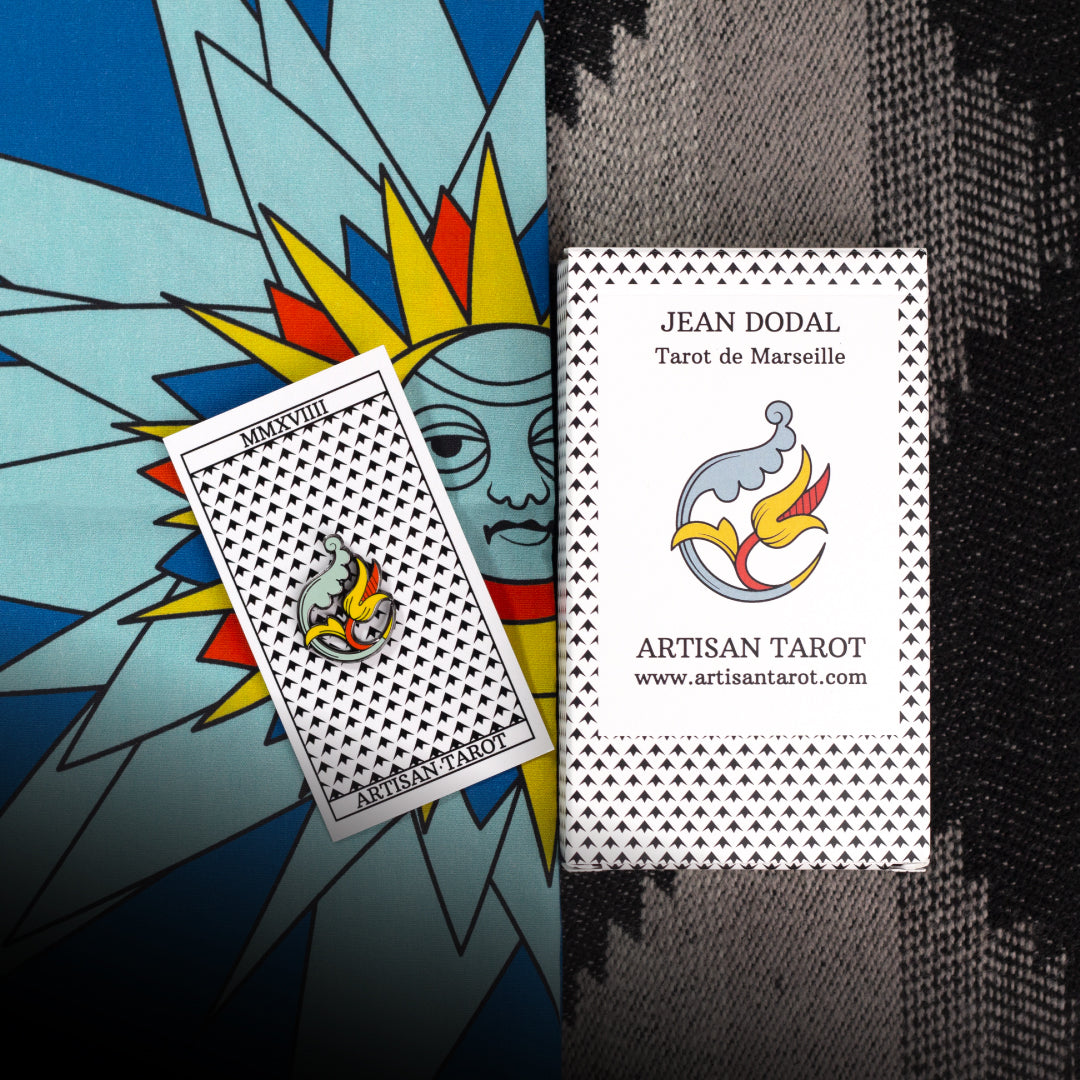
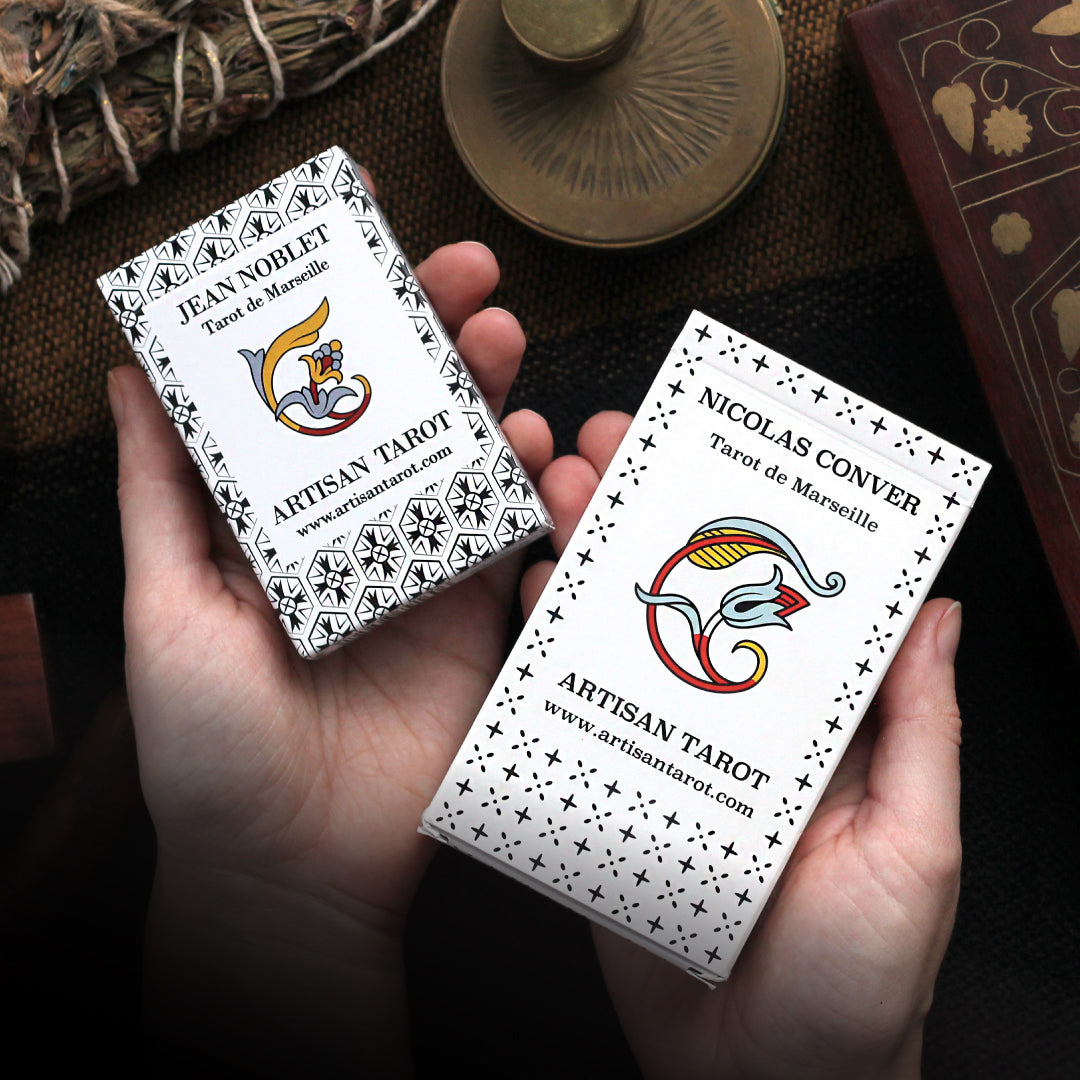
And then there's the other main benefit of Tarot de Marseille, the thing I really love, which is just that the cards look so cool. And I know aesthetics are going to be, you know, different tastes for everybody, right? But I just really like clean, simple art. And what really made me realize that is that my favorite tarot artist is actually Alejandro Rozan.
Now, to date, Alejandro Rozan has produced four decks, and I own two of them: the Tarot des Ambiguïtés and the Rider Marseille. He's recently self-published a deck called, I believe, the Pixie's Marseille, which looks very interesting, and I want to get my hands on that as well pretty soon. But I love his artwork because he evokes that same simple, honest Marseille style of artwork that all of that just shines through with his decks, and it makes reading his decks such a wonderful, pleasant experience. His work intentionally captures that mood that I'm looking for when I'm doing a tarot reading. And while that mood is especially strong when I'm using one of Rozan's decks, it's really one that I still feel low-key anytime I'm using a tarot de Marseille deck. There's just something genuine about it.
The most honest tarot
Now, I have a lot of reproductions of decks that were created in the late 1700s, early 1800s, everything that predates the Rider-Waite-Smith deck. And you know, they have a lot of Egyptian imagery in them, and some of them add extra cards and do all of this stuff to try to get you into this esoteric mood.
And I have a lot of modern decks that try to do that as well, where they'll add a lot of mystic symbols, and, you know, scary bird images and all this other stuff. And none of those really put me in the mood of this ancient liminal space, quite like the Tarot de Marseille, which just takes the same images that were used for gambling way back when, that were just the simple, honest images- the same images that a lot of the early Roma travelers were reading when they inspired the practices that would later gain all of the fake, ahistorical, religious stuff, you know, all of the stuff that they were trying so hard to add to tarot. I just feel like it was already there.
And in a craft that constantly gets called out for all sorts of things, like, you know, it's being fake or being scammy, you know, like again, I was doing all that research on the Miss Cleo Tarot Power Deck and hearing all of these accusations of how tarot is one big scam and tarot artists are trying to steal money from your grandmas and all this other stuff. And all of that comes from the branch of the divination arts where they're trying to convince you that this is all based on ancient Egyptian stuff or ancient Kabbalah wisdom and all of that. And yet, the genuine cards that were produced in a hurry by some block carver in 1500s Marseille, France, that to me connects me far more to history and has a far more esoteric liminal experience that helps me interpret the stories that I'm seeing before me in the images.
So if there's one reason I can recommend the Tarot de Marseille to anybody, it's just the most honest tarot. And having that honesty in my corner when I'm trying to give advice to other people is just it feels a lot better to do. It boosts my confidence. And really, if you're gonna do the divination arts for other people, any source of confidence is a big thumbs up from me.
Closing and where to find us
This has been the Art of Divination Podcast, presented by Artisan Tarot, publishers of historical tarot decks and your one-stop shop for all things metaphysical. Visit them online at www.artisantarot.com. As for myself, I've been Z Mann Zilla, and you can find more about me at www.Pandangit.com. I wish you all the best of luck on your own divination journeys. Happy reading, and thank you for your time.