

What do I think of oracle decks?
I get asked about oracle decks a lot. People ask me, what do you think of oracle decks? Are they any good? Should I be using them? That sort of thing. And my general opinion on the matter is: use whatever you want. I'm not your dad. But you know I also understand why the question's being asked. People want to know about its legitimacy. Does it count as a divination art?
And as a person who got popular on TikTok by reading Sesame Street flashcards, well, I don't know if I'm the best person to discuss its legitimacy. But as we discussed in the last episode covering the Tarot de Marseille, I think legitimacy has a lot of wiggle room in it. So why don't we take a shot at having this little discussion?
So today on The Art of Divination podcast, we will be talking about oracle decks. We'll discuss a little bit of history, some of their modern and popular applications, and discuss, you know, how you can use them and why you might want to. So sit back, relax, and join us as we explore the art of divination.
What I mean by an oracle deck
Welcome to The Art of Divination Podcast, presented by Artisan Tarot. I am your host, Z. Mann Zilla, and on this episode we'll be discussing oracle decks. And I suppose the most responsible place to start the discussion would be to define what oracle decks mean, or more to the point, what I mean when I say oracle deck for the purposes of this episode.
So keep in mind, as you're listening, that I am specifically talking when I say oracle decks, I'm specifically talking about decks of cards that are explicitly made for that purpose. They have a bespoke reading method that was invented just for them. They tend to not have a set number of cards, so they can be any amount of cards that the creator wishes them to have, and they are primarily designed to be used by a single person with little to no experience with the divination arts.
Why Lenormand isn't included
I feel like I have to make this distinction because the Lenormand deck is often cited as being an oracle deck. And I want to start by explaining why I'm not going to be including the Lenormand in this discussion. First off, the types of oracle decks I'm going to be talking about today are very purpose-created. They were made specifically for what it is that they are to be used for. By contrast, the Lenormand system was actually based off of a game called the Game of Hope.
It was a pre-existing game. So it shares a lot more with tarot in that aspect, because as we discussed in previous episodes, tarot started out as a card game as well. As such, Lenormand decks tend to also have the same number of cards with the same symbols in them. Also, as we'll get into later, oracle decks tend to have a different reading style. You'll usually pull just one card and meditate on that, whereas Lenormand uses primarily a tableau system where you're laying all the cards out in one big spread. And typically when you're doing spreads like that, that's not what I'm talking about when I'm talking about oracle decks. Again, for the purposes of this episode.
But rest assured, I do have an entire episode planned that will focus on the legacy of Madame Lenormand and all the divination arts she inspired.
A short history of oracle decks
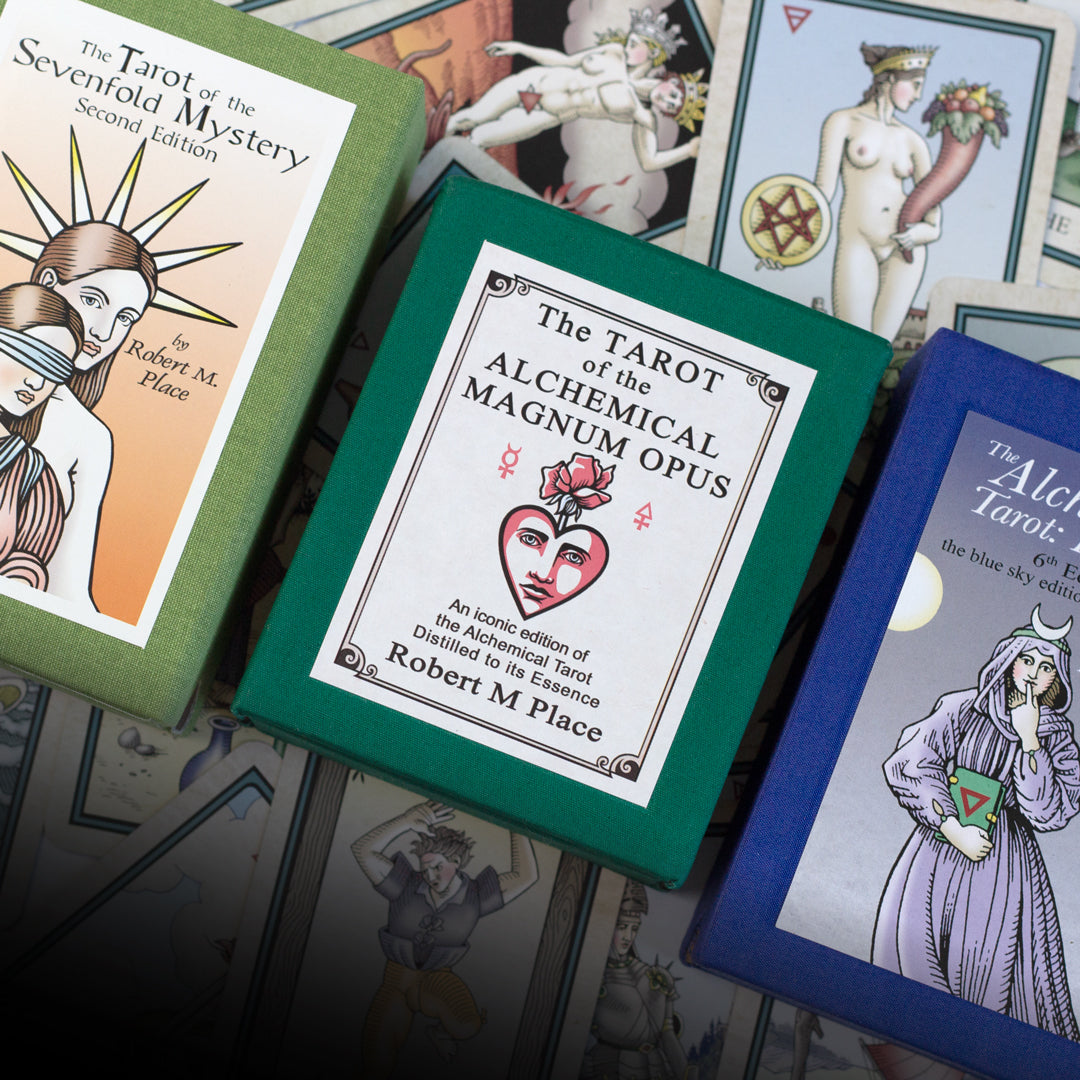
So with that out of the way, let's discuss a little bit of history of where oracle decks came from. Because even though we tend to think of them as sort of a contemporary invention, they've actually been around for quite a while. Now, for this section, I'm going to be leaning heavily on a piece by Robert M. Place, the creator of the Burning Serpent Oracle, that he wrote on October 25th, 2015, called A History of Oracle Cards. It's a very great read. I think you should all check it out as well. And I do want to thank Robert for that resource.
Fortune books in the 16th century
In the 16th century, there was a type of oraculum that was pretty popular. It was known as a fortune book. It was sort of a self-directed do-it-yourself fortune-telling method. You'd have a book that had a lot of poems or prose in it, and you would use cards or dice, using some sort of a system that'd be described in the beginning of the book, to determine which of the entries in the book would apply to the question that you're asking. Notice this is very similar to the modern method of learning tarot, where you draw your cards and then you look the meanings up in whatever guide you have to hand.
Now, anytime you have a process, some genius is going to come along and go, hey, how can we shorten the distance between point A and point B? What steps can we remove?
Lenthall's Fortune Telling Cards, 1665
Enter John Lenthall's Fortune Telling Cards, originally published in England in 1665. This was a 52-card deck. It had 10 pips and three royals in each suit, so very similar to a poker deck. On each of the king's cards was a list of possible questions that you could ask the deck, and then lists of answers could be found on the even-numbered pip cards.
Now, according to the aforementioned author Robert M. Place and his article, he says the method of divination was described often as complicated or convoluted, and as such, he didn't go into how it actually worked in his article. But it does represent one of the earliest known examples of an oracle deck.
Hooper's Conversational Cards, 1775
There's also another deck that was produced in 1775 called S. Hooper's Conversational Cards. This is also considered an early example of an oracle deck. And for me to count it in this, I have to go a little bit outside of the definition that I described earlier, because these cards were called conversational cards, and the reason why is because they were kind of designed to play a conversational game with your friends, similar to Exquisite Corpse. The idea being you would lay cards out, and then you and your friends would try to make a story out of those cards.
And as we discussed in the previous episode about the Tarot de Marseille, and specifically the chapter about The Castle of Crossed Destinies, this is actually a valid way to put together a fortune. But it also kind of puts Hooper's conversational cards a little bit closer to what I was talking about with the Lenormand deck, and kind of puts me a little off track of the thesis I'm going for here. So you know what? Well, I'm including it just for the sake of completion.
The Clergyman Cards and the daily draw
But another historical deck I do want to mention is a deck that was produced in the early 18th century. It was called the Clergyman Cards, as part of a set of morality cards. The idea behind these was that you would draw one card every day. Each one would be illustrated with some sort of moral or life lesson that you were to meditate on for the day. And what I like about these is that they demonstrate one of the most common ways oracle decks get used nowadays, which is single card draws, giving you a daily meditation. And for me, at least, this is what defines oracle decks, or more to the point, differentiates them from tarot. The use case of them being that they are more for delivering affirmations than seeking direct advice, or for that matter, communing with the divine, which is a way that a lot of people use tarot. Oh, wait a minute, there are oracle decks designed for that as well.
Angel decks
So if you do a search for oracle decks nowadays, you're gonna see a lot of stuff out there. There's a lot of decks. Artisan Tarot sells a bunch of them. There's a couple like the Bob Ross one, that I'm really eager to get my hands on. And then we discussed earlier the Serpent Oracle deck, which is based on the Lenormand.
But there's a lot of decks out there that you'll see that fall under this subcategory that I call angel decks. Now, while a lot of oracle decks we're going to be discussing today don't have any sort of inherent spiritualism in them, angel decks very much do. The cards will have pictures of angels and archangels on them, and many times the guidebooks will explicitly say that you're getting divine inspiration from your guardian angel.
Where angel decks came from
Now, I'm no stranger to sharing my unsubstantiated personal opinions in these podcasts, so I'm just gonna say my own theory as to where angel decks came from. There are many religious beliefs, Christianity in particular, that believe that doing any sort of divination or prophecy or fortune telling or anything like that is a sin.
In fact, one of the joking nicknames that friends of mine and I have for tarot is the Devil's Uno. But since angel decks depart from the methods used by tarot and other popular fortune-telling systems, and the imagery in them is very much angels and archangels and biblical references and side references and things of that nature, I believe that this is a way to sidestep that taboo. A way of making the divination arts accessible to folks who wouldn't normally be able to do that because of their religious beliefs.
Now, of course, the punchline to that joke is, as I've discussed in the past, there's nothing inherently spiritual about the process of the divination arts. You can do them regardless of what you believe in, and even if you don't believe anything at all, I consider myself a secular reader.
Sincere intent, and its secular version
With that said, because there's nothing inherently spiritual about the divination arts, it also means that any divination method can become explicitly spiritual. There's a belief in Judaism; it's called Kavanah. It means basically sincere ritualistic intent. The idea that a sufficient focus is the most important element of any spiritual ritual. It's what makes it a spiritual ritual. As an example, without Kavanah, a communion ritual just becomes you eating crackers with some wine. Kavanah is that idea of putting yourself in that mood, that mental and spiritual place where you are wholly dedicated to what it is you're doing on a spiritual level. You're connecting with that spiritual level. And regardless of the system, if you perform your readings with this sincere focus of intent, you are adding that layer of importance to what you do and thus inviting that divine inspiration.
And as it turns out, angel oracle decks make that process a little easier. The angels are right there; the messaging is right there. So it's much easier if you are a believer in angels and archangels and celestial intervention by way of guardian angels. You will achieve that Kavanah a lot easier by using these angel oracle decks.
Now there's a secular version of this as well. In my head, I call it kayfabe, which is a term that comes from professional wrestling. It's essentially the suspension of disbelief, for lack of a better term, that allows you to get into what it is you're watching. I guess authors would call it verisimilitude.
But I mean it's the same reason we turn off the lights when we're watching a scary movie or we play somber music during funerals, we light candles to make a dinner date more romantic. These are all things we're doing to get ourselves fully and wholly into the mood of what we're doing. So if you're the type of person for whom angels and archangels and guardian angels figure very strongly into your spiritual beliefs, then angel oracle decks are a great way to get into the divination arts.
Oracle decks in therapy and self-care
But it seems like a lot of what we've been talking about so far has so much to do with getting divinely inspired advice or getting a message from the universe about a problem you might be having. And those really aren't the only problems that oracle decks are designed to solve. In fact, there's another use case that's becoming very popular that's just a bit more mundane, but no less important. I've had the honor and pleasure of doing a lot of lecture series over at www.artisantarot.com for their membership section. And one of the series that I did was something I called How to Read Anything.
It was a 12-part series where I basically discussed how the divination arts can be applied to just about any object that can be sorted or randomized in some way. And these discussions often come with some sort of a Q&A at the end. And one of the trends that I've noticed is it seems like I attract a lot of folks in the mental health sector who show an interest in tarot and have even expressed ways that they use it in their practice. A common one is they let me know that they use it sort of like a Rorschach test.
But part of this has to do with the fact that tarot, and one of the ways that it works, is that it is a reflection of what you're already thinking. You tend to draw meaning from the cards based on something that's already within you. And as a result, you can use it, very similar to a Rorschach test, to show somebody a card and say, What do you see here?
And then make a note of those results and get some insight into what's bothering the patient. Of course, I imagine a non-zero number of you heard that and went, I'm not sure I support the idea of using some occult tool in some sort of an official therapy setting; that feels wrong somehow. And yep, oracle deck producers are there with you, which is why we're seeing a lot of oracle decks that are designed for purposes of things like therapy and self-care.
A self-love deck, and one from my own therapy
Now, back when I used to do tarot deck reviews for TikTok, one of the decks that was sent to me for review was something called The Local Honey Picture Box, produced by Emily Wilcox. It's a 44-card deck, beautifully illustrated, and has a focus primarily on self-love. And all the cards have little bits of advice at the bottom of them, things like be your own sweetie or follow the inverse golden rule or see yourself, things like that.
And then what you do is you draw a card, and then you look up that card in the guidebook, and it gives you a more expanded write-up about what that advice is supposed to mean for you and what those concepts mean. And as I discussed in my review of the cards, this really doesn't make them, you know, immediately accessible for doing sort of divination readings, at least the traditional kinds, or traditional and big quotes, is what I did for Sesamerot, but they're still great for what it is they're designed to do: to give you this sort of random affirmation for the day, give you something to focus on, a positive thing that you can do for yourself. It also reminded me of a similar deck of cards that I ran into while I was doing CBT for my own mental health journey.
And I remember it was a similar deck of cards with these illustrations, and they had all these little messages on them. The only one I remember clearly is the one that I drew on my last day, which said, I am open to new avenues of income. And I remember it because, ironically, about a month after that session, I lost my job, but it was losing my job that started me on the journey towards what it is I'm doing nowadays, including doing all this great work for Artisan Tarot, getting to talk to all of you about tarot and all of the other fun stuff I do in my side gig, doing graphic design and video editing.
So if I had had to pay attention at the time, I might have observed that that's just a valid form of divination right there now, isn't it? All of this is to say that because oracle decks are purpose-made and have the ability to depart, if they want to, from esoteric roots, that gives them the ability to focus on what it is that they're useful for. And it also adds a layer of user-friendliness to the whole affair.
Will an oracle deck teach you tarot?
I'll admit, though, that the user-friendliness is both a blessing and a curse. Let's get into why. And I'm gonna level with you, this is a really hard one to answer without sounding mean. So please bear with me. I swear I'm trying to be as nice about this as possible. The main way that oracle decks work is basically by doing a lot of the heavy lifting for you, which, generally speaking, is not a problem. There's nothing wrong with a little bit of ease and convenience in your process.
The thing is, if someone is specifically asking me, will using this oracle deck ease me into tarot, will it teach me the processes of doing tarot? I'm a little iffier on that. I don't have a clear answer on that. Some of my peers would like to use the training wheels metaphor, but I feel like that's not even the same thing. I feel like a transition from oracle decks to tarot would be a little closer if you were to describe it as going from a Power Wheels tricycle to a bicycle. With an oracle deck, you're certainly going through the motions of what looks like a tarot reading, but a tarot reading requires a lot more input from yourself. You've got to be constructing narratives; you've got to be deciding what the symbols mean and how they relate to one another.
There's a lot of heavy lifting that's going on on your end. Even folks that are very reliant on the guide are still mostly using sort of vague ballpark meanings and keywords to get to where they need to be. Whereas typically an oracle deck is just giving you straightforward information.
Use them alongside tarot, not instead of it
So if you're looking to oracle decks as a pathway towards tarot literacy, I wouldn't recommend it for that. I would consider it more a parallel practice, something that's fun to do on the side, or even something that can accentuate your readings by being done alongside a tarot reading. One application I've seen, for example, is to use the oracle deck to decide what it is you're supposed to be thinking about today, and then, based on those thoughts, doing a tarot reading. Using the oracle deck as a starting point to get your brain jump-started. Along those lines, you can also think of oracle decks as a quick snack, just something quick to think about. Most oracle decks emphasize a method of just drawing one card and using that as your meditation for a set period of time, usually the day.
And if you have a practice where you're doing tarot for others, say like I do on my Twitch channel, you can have an oracle deck handy as sort of a little bonus thing that you can do, sort of like the fortune cookie at the end of the Chinese meal. I actually have a Zoltar fortune telling deck.
This is an oracle deck that's based off of the fortunes that used to come out of those Zoltar machines. I don't know if you remember those. They were featured in the movie Big. But each card includes a random bit of advice or an affirmation that reads out pretty quickly. I can usually get one read in under 60 seconds, and of course, time is a premium when you're on a stream. And it also includes lucky numbers, which is a fun little feature of a lot of mid-20th-century fortune-telling anyway.
Match the deck to the question
But basically, if you're looking to get yourself an oracle deck and figure out a way to use it, the most important part is to make sure that the oracle deck fits what it is that you're trying to do. Because again, oracle decks tend to be focused in a specific area. They're not so much like a reading where somebody asks you a question, and then you're divining an answer from the symbols you get. It's usually more along the lines of here's the questions this is good at answering. And usually those questions are very broad, something along the lines of, what should I be thinking about today as related to topic X? One good example of this would be the Writer's Oracle deck and guidebook produced by RP Studios.
You can find that one at www.artisantarot.com as well. But it's a toolkit for writers. So, you know, if you're looking for advice with what you should be writing or what to do next, that's a good oracle deck to pick up that can give you those randomized prompts to get you going in the right direction.
Now, this isn't to say that oracle decks can't delve into those areas of divining a meaning from a vague set of symbols. There's a lot of oracle decks that are designed to do that as well. The one that comes right off the top of my head is something called the Cerulean Sequence. It's a 60-card deck; it is super weird. It has a lot of sacred geometry and numerology stuff in it, and you're definitely going to need the guidebook the first several times you use it.
But if you want something that's gonna get your brain thinking in directions it wasn't thinking before, this is a good example of an oracle deck that can help you do that.
Decks you can outgrow the guidebook with
Of course, one of the things I'm finding I really enjoy when I'm checking out oracle decks is oracle decks that can eventually evolve past you needing the guidebook and being able to develop your own storytelling systems from them. These will often be decks with little to no text on the actual card, and with the idea being that you look everything up in the guidebook and get your affirmation.
But what if you don't use the guidebook and you just make up your own spreads with what's in front of you and just let yourself be told a story from the pictures? It's one of the reasons I'm looking forward to getting my hands on the Bob Ross Oracle by RP Studios. I'm a big fan of Bob Ross, so obviously that's going to resonate with me. And there's another cool one I spotted called Endless Journey, which is a bunch of cards that are all based off of the same scene, which is really cool.
So the images all relate to each other regardless. Your brain can't help but tell itself a story based on the images that you draw. So that seems like it has a lot of post-guidebook potential as well as a fortune-telling device.
Make your own
Now, with all that in mind, I've been sticking to a pretty narrow definition of oracle decks: this idea of decks that are published with this specific use case in mind. And so I'm going to go ahead and treat myself here. We'll expand that definition just a little bit so I can talk about a couple other things that I really think are cool and ought to count as oracle decks. For starters, there's this board game from France. It's called Dixit. And the cards that come with the game are just all painted images. The gameplay itself centers around trying to guess what somebody titled one of the pictures.
But you can actually use the cards themselves as their own little fortune-telling deck in very much the same way that I was describing, where you take one of these decks and you just sort of throw away the guidebook and let it tell you the story that just comes to your mind. This is very much in spirit of how I came up with the Sesamerot, which is where I bought all of these Sesame Street flashcards from the dollar store and started using them as an oracle deck, essentially.
And if you're feeling especially creative, go out and get yourself one of those decks of blank cards. A couple years ago, I actually made myself my own oracle deck based on a book by Kurt Vonnegut called Breakfast of Champions. He has all these little doodles in it. And so what I did was I took one of these decks of blank cards and I drew some of the images from the book, which weren't hard to do. They were very simplistic drawings.
But so I'd draw them and then I'd draw a little quote underneath each of them that was on the same page or in reference to the image that he had drawn, and I made myself a little deck of cards out of that. So think about that. Think about how your own creativity could create for you your own oracle deck. You know, we talked about Kavanah and spiritual intent earlier.
Well, what better way to express your intent than a deck of cards that you created for a purpose you understand? Your connection to those cards is gonna be so much stronger because you made them and you understand what they're supposed to mean. And it's not like you have to be a great artist to do that. You can draw stick figures; you can write just words. I mean, again, one of the things we talked about earlier, angel oracle cards, tend to just be a ton of script over a picture of an angel.
So, you know, you can literally just make cards that are just a bunch of words. In fact, some of the earliest oracle decks we were talking about were really just that. The point is that another nice thing about oracle decks is that you can home make them. Oracle decks are a reminder that traditions and methods and theories and all of the stuff that's connected to the systems that we understand, all the, you know, the divination systems that we ascribe these deeper meanings to and that we chart the histories of and all that, those are all well and good. Those are great because that connection to history does help provide some of that Kavanah that we were talking about earlier. What I like to think of is provenance, knowing where something comes from.
That adds a layer of gravitas and importance to what it is you're doing. But again, let's not forget that oracle decks started as a way of getting us a shorter path between point A and point B. It was a way of taking fortune-telling books and making them simpler to use. So anything that shortens your path between yourself and your understanding of the divination arts is a good thing. And what shorter path is there than you made it yourself? And that's also what I like about a lot of these oracle decks that are simple images with little to no text on them. You also have a lot of opportunities to create those connections for yourself as well. They become yours, and they shorten that path between yourself and your understanding.
So, bottom line, are oracle decks a pathway towards learning tarot? Not necessarily. Doesn't make them invalid, though. Doesn't make them wrong. Oracle decks may not lead to tarot literacy, but they can lead to something arguably more important. Self-literacy.
Closing and where to find us
This has been the Art of Divination Podcast, presented by Artisan Tarot, publishers of historical tarot decks and your one-stop shop for all things metaphysical. Visit them at www.artisantarot.com. As for myself, I've been Z. Mann Zilla, and you can find more about me at www.Pandangit.com. I wish you all the best of luck on your own divination journeys. Happy reading, and thank you for your time.