Why randomness matters
If there's one thing most, if not all, elements of divination arts have in common, it's the concept of randomness, or using an object whose output is randomized in some way. Now, mathematicians will be quick to point out there really is no such thing as something being totally random, at least not in the way we think of randomness, and on that I would actually agree.
But why is working a random element into the practice so important? Well, that's what we're going to discuss today, along with some of the ways divination artists achieved that randomness before cards became the norm. And yep, this one's gonna be a history-heavy one, so sit back, relax, and join us as we explore the art of divination.
Cards are not the whole art
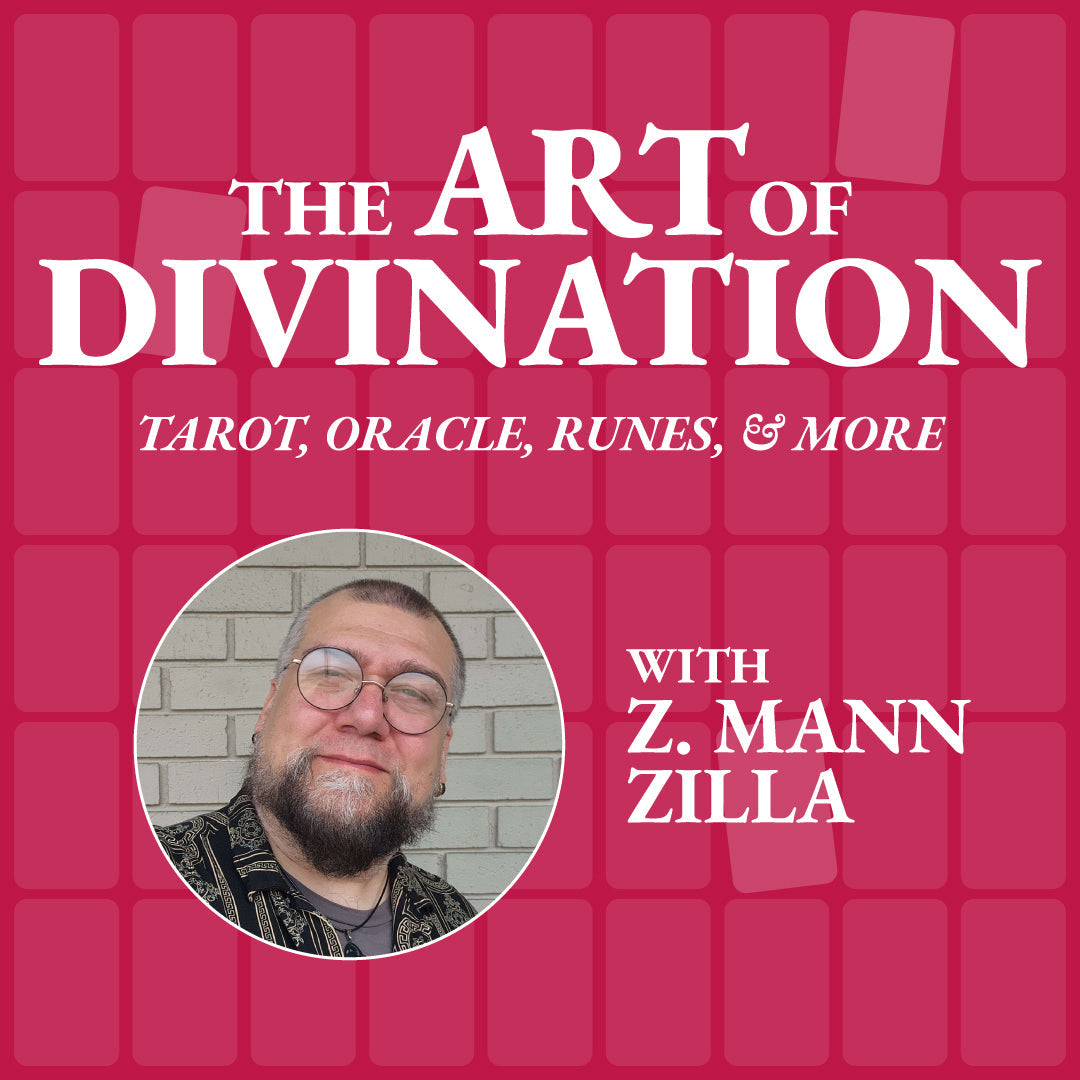
Welcome to The Art of Divination Podcast presented by Artisan Tarot. I'm your host, Z. Mann Zilla. On this episode, we'll be discussing randomness before cards. Now, the main reason I wanted to do this episode now is because I like to think of these podcast episodes as building upon topics that came before. So I do have to start with a bit of an apology. You see, so far everything we've talked about on The Art of Divination Podcast has dealt with cards. The most popular divination arts tend to center around decks of cards.
But I feel like that's a bit of a disservice. The Art of Divination isn't just cards. Cards are, of course, a common divination tool, but this would be a little like saying that the only thing to construction is hammers. But there has to be a reason cards are such a foundational element of modern divination arts, and it's basically because they're just an easy way we can express one of the foundational elements of the divination arts, which is randomness.
Nothing is truly random
Now, the most common understanding of randomness is that when something is random, it happens without a definite purpose or pattern in any way. There's no plan causing that result to happen. That's what a lot of people think of as random. The thing is, the more you think about it, the more you realize nothing in the universe could possibly be without any sort of purpose or pattern. Everything is sort of a cause and effect of something that's happened before. Think about it. When you're shuffling your cards, the resulting order of the cards is really determined by how the cards bang together as you're throwing them, which itself is based on the order they were in before you started throwing them into the shuffle, and so on and so forth.
The order seems random to you because you know they're all face down, you're not looking at them, but the way that they end up, there is a predetermined way that happens. If you shuffled those cards exactly the same way a hundred times, you would get the exact same shuffle a hundred times. And really, everything works like this to some degree. You know, anything that has happened is sort of the result of things that have happened before.
And when we talk about this, a lot of people will say, Oh, well, does that mean everything in the universe is predetermined? Sort of. The thing is, it's all also happening to such a complex degree that, yes, you could theoretically chart it; figuring out what everything that would happen in a single moment would take you an infinite number of moments to do. Again, I know there's no such thing as true infinity, but bear with me here. The amount of time it would take you to calculate perfectly all the reactions of every atom in the universe in a single moment would take you longer than the history of the entire universe every single time.
What divination does with randomness
So the way I think of the divination arts and the way it deals with randomness is that you're taking something that you do understand, throwing it at something you want to understand, and based on the way the thing you understand reacts, you sort of ballpark the results. And yeah, it's not a scientific process, but you know, we're not trying to do scientific things with the divination arts. We're not trying to end wars or you know, cure cancer or anything like that. We're just trying to determine what your crush feels about you or whether you know you should go for that job interview, things like that.
Which isn't to say the divination arts didn't get used that way in the past. But even the people that used it that way thought randomness was important. They just needed something other than cards to pull it off.
Casting lots
One of the earliest recorded forms of divination is known nowadays as cleromancy, or as it was known or recorded back then, the casting of lots. This is a general term that refers to a lot of different techniques, most of which aren't recorded in any way, and a few that are, depending on what area of the world you're talking about.
For example, there's a 10th-century practice known as Omikuji that was performed in Japan, and this one was very simple. It would just be slips of paper that had little fortunes on them, and that would be placed all together in one big receptacle, and you would pay to be able to randomly draw one of them.
Casting lots in the Hebrew Bible
But we can't discuss the history of casting lots without mentioning where it was first mentioned, which was the Hebrew Bible. Now we've discussed in the past how Christianity currently, at the very least, has a lot of taboos against the divination arts, against fortune telling. And by and large, you'll see that a lot of those taboos actually emerge from a lot of the works of the New Testament.
But when you go through the Old Testament, you see a lot of examples of folks casting lots for very important reasons, even. The casting of lots, for example, was used to divide the land of Canaan among the twelve tribes of Israel. There are also numerous examples of casting lots used to determine the guilty party when a crime is committed. And you may be wondering, because actually, cleromancy is not even the only form of divination that's discussed in the Bible. There's also sections that talk about belomancy, which is the use of bow and arrows. There's at least two examples of that in the Bible. But you may be wondering: if the Christian Bible contains so many examples of divination arts being used, then what's with the taboo?
Why is it taboo?
And the justification lies in the book of Proverbs, specifically chapter 16, verse 33, which says, and I'm quoting here at least from the King James Version, the lot is cast into the lap, but its every decision is from the Lord. Based on this passage, a lot of modern-day Christian theologians will defend the modern-day taboos of divination by explaining that these practices were actually reserved for the priests and temple leaders of the time. You may remember from the Oracle Deck episode, we talked about Kavanah or sufficient fervor, you know, the idea that you know you had to be in a specific state of consciousness in order to perform these arts. That was considered very important to the whole process, so much so that the process of divination couldn't be trusted to just the lay people, only priests could do it.
Randomness as an expression of faith
But getting back to what we're talking about in this episode with randomness, the randomness was a very important part of the lot casting process. So while we don't have exact instructions on what it is they actually did, you know, the theories tend to revolve around either they use bits of pottery or colored stones or marked sections of a stick, you know, whatever the process was, we know that it was a random process. And we also know that that randomness was actually part of their Kavanah.
It was them expressing their faith in God. Their understanding of randomness, very similar to the one that mathematicians have nowadays, was so that God had a space to come in and manipulate the tool. They simply had faith that God would manipulate the tool in a way that would give them the answer they were looking for.
Furthermore, the other thing to keep in mind is that they weren't casting lots for a lot of the reasons that we do the divination arts nowadays. You know, nowadays people will come looking for love advice or, you know, a decision between two different paths or something to that effect. And the divination arts are very available to people as a result, both the doing of and the seeking of people who do it. Back then, not so much. The divination arts were reserved for big important questions. And because those were such big important questions, a lot of times they were willing to put a lot on the line to get those answers.
A content warning
Now, this section's gonna be going into some slightly more gruesome areas. So, a little content warning for that. I'm gonna try to not be too graphic, but I will say that anything you hear about here, do not try this at home. I'm serious; I'm bringing all of this up for the sake of historical record and our discussion.
This is not advice. Do not incorporate what I'm about to talk about into your practices, please and thank you. But this is the chapter where we deal with the divination arts that achieve their randomness through some form of sacrifice.
Reading livers
Now, the reading of animal entrails is common in many cultures. There's many that do it. However, few documented their process quite as well as the folks who practiced haruspicy. This was a Roman divination art in which the future was divined from the liver of a sacrificed animal, and those who performed it were called a haruspex.
And if you're familiar with the video game Pathologic, you now know where that term comes from. Now there are records of this practice happening as early as 1900 BC. Well, I say records; what's actually happened there is that they found some clay models of livers that they dated to that time. However, a lot of what we know about haruspicy nowadays comes to us thanks to the liver of Piacenza.
Now, this is a bronze model of a sheep's liver that was found in Italy in 1877. The idea was whenever they had something that they wanted to consult a haruspex about, they'd bring in the sheep, sacrifice it ritualistically, remove the liver, and then they would look for little discolorations on the liver. And wherever the section of the liver where the discoloration was, they would compare it to one of these reference models, and it would let them know if this was a favorable or an unfavorable omen.
And in cases where the omen was unfavorable, often there was a god or goddess that they could petition to try to make it a favorable omen.
A lot of work for a yes or no
Now, if I could be allowed to editorialize for a moment, and even if I'm not, I'm gonna anyway, but this all seems very wasteful for a technique that produces basically a yes or no answer. Consider, by contrast, one of the oldest divination methods known to the Hebrew priests, which was the Urim and Thummim, also only produced a yes-or-no answer, but it did so with two stones. You didn't have to go and kill a whole sheep to get that answer from God. Thankfully, if this is an art that you're willing to explore, it turns out that there is an oracle deck version of this. Reverend Robert Lee "Skip" Ellison created a 44-card Divine Liver Oracle deck along with a guidebook. It's a bit of a chore to find them.
I did manage to borrow a set of these cards from Dr. Jeremy Weiss over at the Temple of Miriam, along with the guidebook, and have a look at them. Now, the good news is if this is something you want to try out, you don't have to kill a sheep to do it. The bad news is you have to instead go to two different websites, one place to buy the deck, the other to buy the guidebook, and by the time you get all of this stuff together, you basically have an oraculum that can only give you a yes or no answer, which to my mind just flip a coin.
But you might be asking, where's the randomness in all of this? And of course, part of that randomness is, well, you can't actually see inside of the sheep until you kill it and remove its liver. So there's your randomness right there. Presumably, the pantheon of gods and goddesses has directed which of the animals is to be sacrificed, or even that they chose to touch the liver of the sacrificed animal in some way, so that after it is sacrificed and you remove the liver, you get the message from the god. And that there's your randomness right there.
Sacrificing your own health
But that's just one form of sacrifice. Another would be sacrificing your own health. And I'm gonna repeat: do not try this at home. Another method of divination which crosses cultural borders is inducing hallucinations. You're probably familiar with stories of people using substances like peyote, ayahuasca, mushrooms, things of that nature to go on spirit journeys or something similar to that. What's happening there is that we are randomizing the effects of our own body chemistry to leave space for a divine message to come through.
This is obviously not a very healthy way of doing the divination arts. But if you can believe it, there are historical versions of this that are even more unhealthy. For example, the Oracle of Delphi is said to have been sat over a vent producing toxic natural gases. They would sit the high priestess of the Oracle of Delphi on a tripod over a vent, producing toxic natural gases, and she would just start ranting and raving, and then nearby priestesses would then take note of the ravings and then try to interpret them into some prose that made a bit more sense. I'm gonna say it a third time. Do not try this at home.
Starvation and dehydration
And while these are all very unhealthy ways of getting to that hallucinatory state, one of the more popular ones and one of the more ubiquitous ones, and in fact, you can guess that it's been in the Bible a lot. You have to read between the lines a little bit, but once you see it, you can't unsee it. And that's people who would get themselves to a hallucinatory state by purposely starving or dehydrating themselves. Think of all the times somebody had a revelatory vision after wandering through the desert for a long number of days.
This is also a practice known through the records of the ascetics of regions such as India, where they would meditate for days, eating very little, drinking minimal amounts of water. In fact, Siddhartha Gautama, who would eventually become the Buddha, was known to be this type of a monk before finally achieving the Buddha state. Another example is the Amazulu of South Africa, who described the process of creating an inyanga or diviner, by having them go on a starvation diet, which could last as long as two years during their initial initiation. During this, they would become dehydrated, emaciated, and haunted by dreams.
So, yeah, when you put your body through this level of abuse, which fourth time's a charm, do not try this at home. That is going to randomize your body chemistry, which produces that random effect that we've been talking about.
Casting the bones
Now let's go ahead and back away from this topic into something that we would recommend that you could try at home, although one of them is going to involve bones. There's a great book by Michele Jackson. It was produced by the Lucky Mojo Curio Company, and it's called Bones, Shells, and Curios, a contemporary method of casting the bones. It outlines the modern form of an art that's been practiced throughout history called osteomancy, which is the study of bones.
Now, in modern osteomancy, you can use things like shells, curios, beads, dice, all kinds of other stuff. You put all of that in your charm bag, and then you take those objects, you know, while you're asking your question, you shake your bag, and then you ask your question, and then you throw it out onto usually a surface with a circle on it, and you read the bones based on certain criteria from there. And of course, osteomancy is derived from osteo, bones, because the original way the art was practiced was with bones. The meanings of objects in osteomancy were typically derived from things such as what animal did the bone come from, what part of the body is the bone from, what purpose did it serve, things of that nature.
That was the starting point for what the bone meant when it landed on the mat. And it was its relationship to other objects within the spread that determined what that bone meant in the spread. Often, like for example, there you would include, say, a necklace or something like that that would serve as sort of a dividing line or an equator, or perhaps there'd be an object that was meant to designate the querent, right? Like maybe like a little figure of a person and their location in relation to the bone, whether it was above them, below them, to the side, on the other side of the equator line. All of those had different meanings and could give the reader some insight into what the answer to the question was.
Building your own bone bag
You remember when we were talking in the oracle deck episode about how you can make your own oracle deck; you just need some blank cards? Well, when you put together a bone bag for osteomancy, that is basically the only way to do it. But it's very important to do it that way because you understand why they're there, because you put them there yourself.
And if an object doesn't make sense, you just don't put it in. So once you learn the basic process of osteomancy and how randomness is used to derive meaning from the objects, you're pretty much open to put whatever you like in there, and you can really do some interesting stuff with that. A great example is using dice or dominoes. I think dice is a really great little extra add for a bone bag because you've already got all this other randomness going on, so you've got an extra layer of randomness with the die. There's a really great set of dice. They're sold under the name Seeing Stones. You'll find them at www.artisantarot.com. The Seeing Stones are a set of five 12-sided dice that have sort of abstract symbols on all the sides.
So, in addition to the randomness you get from dice and the randomness you get from the osteomancy bag, you also have a third layer of randomness with these abstract symbols that could speak to you in a number of ways, depending on other stuff that's going on in your life or their position next to other things, and so on and so forth.
Now, I've got to be careful when I'm talking about osteomancy, because honestly, I could probably just talk about it all day. In fact, I'm probably gonna do another episode just about osteomancy. I'd really love to go into it with you. It is really neat. But I do want to make sure I'm touching at least a couple of other pre-card systems before we go into our final thoughts.
Runes are newer than you think
And for that, let's go ahead and get started with what the Seeing Stones remind me of runes. Now we're gonna go quickly through runes really quick because it turns out that a lot of what we understand with rune casting isn't quite as ancient as we think it is. Don't get me wrong, when people are talking about Futhark runes, they are definitely talking about those shapes that appear in the Eddic poems, and are definitely an important part of Scandinavian history. However, like the biblical casting of lots, there aren't any instructions in those old poems that detail how to use them for anything.
Furthermore, the poems often outline how the runes are being used for magic spells, not divination. Big difference. But you may be saying, rune casting is definitely a thing, I've seen it, there's books about it, and yes, you're correct. The thing is, most runecasting techniques we know about nowadays were actually developed by a man by the name of Ralph Blum in 1982. Technically, the video game Donkey Kong is older than most of the runecasting techniques that we're aware of.
Furthermore, a lot of the techniques he was trying to teach were derived from reading of tarot, and so for example, he makes a lot of references to doing reversals, which is a tough call when several of the runes look the same right side up as they do upside down. That said, his technique is still valid. I've used a variation of it to read Super Mario Bros. buttons and a technique I call the Shigeru runes.
But the reason I do want to bring up runecasting is because runecasting is an example of doing randomness with smaller sets. Basically, you've got a smaller number of objects, and so the amount of available data is a lot more limited. It's a similar problem to what you run into with the Urim and Thummim that we discussed earlier that could only do yes or no. Pendulums and coins are also examples of small set randomization.
The I Ching does the most with the least
However, there is a technique that has found a brilliant way of dealing with small set randomization to still produce a wider set of results. And I think it's actually pretty impressive. And that would be a humble little craft that was introduced 1000 years before the birth of Christ: the I Ching. Obviously, I'm gonna hype this one.
It is a personal favorite. As many of you know, I've published an I Ching deck for Artisan Tarot, the goal of it being to help people transition from tarot literacy over to I Ching literacy. I do consider it that important. But the brilliance of I Ching is that it starts with a data set of only two objects, a broken line and an unbroken line, and from there can expand out to create a system of hexagrams that create 64 distinct results.
This is one of several reasons why I love I Ching. When it comes to divination systems, it is all business. It does the most with the least, and there's a ton of different ways to use it. And it's one of the reasons why I came up with The Pai of Panda Oracle Deck. See, another thing I love about I Ching is that, you know, we talk about the divination arts a lot of time. It's giving people advice or giving people a fortune.
But in I Ching, what you're giving people is marching orders. I suppose the nicer way of saying that would be that I Ching advice tends to be far more action-oriented. Through the process of your drawing, you come up with where you're at now and where you want to be, and you study the change between those two symbols, and that gives you the precise instructions you need to do to get from point A to point B.
Now, I give the system of I Ching a lot of big ups, right? But the fact of the matter is that because it is an all-business kind of divination system, there are people that say, oh, well, it's not as fun, right? When you do tarot, you get cool pictures, and when you do Lenormand, you get cool pictures, and when you get osteomancy, you get to throw a bunch of stuff around. Those are fun, right?
So I admit it's a hard sell; it's not for everyone. It is really for the people that really want to be able to give action-oriented advice, be able to say to people, you know, instead of saying you will receive a pot of gold or something like that, what you're saying is, ah, you want to find a pot of gold?
Well, this is how you go about doing it, this is the path you walk. And I'm probably also going to be doing a full episode on I Ching at another point in the future, but I do want to bring that back to the brilliance of the I Ching as it pertains to our episode about randomness, which is how we can take just a little bit of randomness and expand it out so far.
You have to give up control
So when we talk about randomization in the divination arts, we don't have to be spoiled for choice. You know, we can use just as few as two objects or even just two results. There are plenty of fortune-telling coins that fit that bill. There are specifically made dice. We talked about the Seeing Stones earlier, but there's also spell work dice and runic dice that combine rune reading with dice to produce these small-set divination techniques, and they still have that randomness; they still have that ability for the universe or your intercessors or whatever you believe is jumping in to give you the answer in that moment. They still create that space. It's just a matter of how efficiently they do that and with how many or how few objects.
But the important connecting factor in all of this is that there has to be an element of randomness; there has to be an opportunity for something that is outside of your control to be able to give you the results that you're looking for. And it helps if it's from a limited data set, one that you understand, but nonetheless, something about the reading has to be outside of your control. That's where the validity of a divination art truly comes from.
It is the beating heart of the divination arts. So whether you call it Kavanah or, like I like to call it, kayfabe, as we discussed during the oracle Cards episode, regardless of what you call it, in order to express it, you have to give up control to the universe. Your tool must be capable of producing a result that you can't manipulate. You can't put your thumb on the scale it in some way, you can't try to make it into something else. You know, it's one of the things that would come up a lot when I was doing Sesamerot for TikTok. People would say, well, how do we know you're not just picking the cards by yourself? How do we know you're not just picking the perfect cards for these things?
And the answer is, it would be pointless if I did. It would be no good. I mean, apply that principle to tarot. If somebody asks you about what's going to happen to me and you go digging through for three cards that perfectly fit the answer you were gonna give, well, then you're not doing the divination arts. You're just creating this long path from what it is you wanted to say to you saying it. That's not divination. That just could have been an email. No, at the end of the day, for divination to be its best for whatever reasons you choose to practice it, you know me, I like to practice it for entertainment purposes, but whether you're practicing it for the same reasons I do, for practices of divination, because it's part of your spiritual track, whatever, and whatever it is that puts you on the path towards the divination arts, the one thing we have in common, the one thing that we all share, is that we have to trust the randomness to some degree.
The goal of the divination arts is to forecast the future. We know that we can't control it. So why should our tools be any different?
Closing and where to find us
This has been The Art of Divination Podcast, presented by Artisan Tarot, publishers and retailers of all things metaphysical. Look for many of the items we discussed today at www.artisantarot.com. As for myself, I've been Z. Mann Zilla, and you can find more about me at www.Pandangit.com. I wish all of you the best of luck on your own divination journeys. Happy reading, and thank you for your time.