

Named after the person who inspired it
One of the ways that we commemorate the contributions that inventors have made to our culture is to name their famous inventions after them. Tarot was, of course, invented by Eli Tarot. I'm just kidding; tarot is actually named after the game that it was derived from, but we refer to the most noteworthy deck of cards in that system as the Rider-Waite-Smith cards.
And when it comes to divination arts, I don't have a ton more examples of that. I Ching just means Book of Changes. If we named rune casting after the most noteworthy person who came up with the technique, we'd be blumming the runes. That might explain why we don't call it that. Osteomancy is named after bones, and as far as I know, there was nobody named Edwin Harrispecs or anything like that.
Which is what makes the Lenormand system such a standout. The entire system has actually been named after Madame Lenormand. Although it is likely she never actually knew about that part. The Lenormand is a really interesting oracle system, and that's why I want to talk about it today on The Art of Divination Podcast. So sit back, relax, and join us as we explore the art of divination.
The best system nobody seems to use
Welcome to The Art of Divination Podcast presented by Artisan Tarot. I'm your host, Z. Mann Zilla.
On this episode, we'll be discussing the Lenormand system. I often think of the Lenormand system as the best system nobody seems to use. And as I'm sure you've gleaned from previous episodes, I'm a bit of a wrestling fan, so this hits particularly hard for me. As this is also a phenomenon in wrestling circles, it seems like your favorite wrestler is somebody that nobody's ever heard of.
Because your favorite wrestler never wrestled on any of the big televised companies. They only seem to work in the indies. And the Lenormand has a similar thing going on with it. I've actually never met another Lenormand reader in the wild. It's not a style of reading that you're going to see very often on streaming services such as Twitch or TikTok Live. Even if you're following divination content on YouTube, it seems like you never get recommended any videos about Lenormand.
But as I've often said during my own readings, be the change you want to see in the world. And so I'm going to talk about this wonderful system with all of you. And let's start, as we always like to do, with a little bit of history. Let's talk about where the Lenormand system came from and where it got its name.
Who was Madame Lenormand?
The Lenormand system is named for Marie Anne Adélaïde Lenormand. Her career as a famous fortune teller and cartomancer spanned about 40 years during the early 1800s. And while there's no really good way to confirm this, she at least claimed to have given advice to a lot of famous people. Among them Robespierre, Empress Joséphine, and Tsar Alexander I. During this time, she also wrote a lot of books, some of which got her arrested.
Now, a lot of this didn't vibe well with her Catholic upbringing. She actually was orphaned at six and had to go to a Catholic school for most of her formative education. But I don't know; I think it's a thing with divination artists. I mean a lot of them, myself included, with strong religious backgrounds that they've somewhat deviated from later in life.
Lenormand's 36-card deck
Now the interesting thing is that while she was a cartomancer, she wasn't using tarot cards like a lot of cartomancers were at the time. She instead more commonly used a smaller 36-card deck that was frequently used for German and French games. This was known as an Ace-Ten deck. And I'd like to segue for a moment to explain just what those are. And the simplest way to explain that is just to say take a standard 52-card poker deck and remove the twos through the fives of all of the suits.
These are referred to as Ace-Ten decks because they were used to play Ace-Ten games, which are games where the scoring system put a premium on the aces and the tens typically. And a lot of times, the jacks were considered the high face card. The national card game of Germany, and it has one of those, that's interesting, is called Skat, and it uses one of these decks. Switzerland also has a national card game, as it turns out. Theirs is called Jass, and it uses the same deck but different rules.
Anyway, this was the particular deck of cards that Madame Lenormand used in her practice most frequently. And so after her passing in 1843, to commemorate her legacy, people started to sell Petit Lenormand decks of cards that were meant to be used specifically for cartomancy. Now, while these cards had the same pips and face cards that we're familiar with, they were also printed with images that came from another game called the Game of Hope.
The Game of Hope
And here's where we have to segue again because now I have to explain what the Game of Hope is, or was, I suppose. I don't think anybody plays it anymore. But it's important to understand why this system is so fascinating. See, the Game of Hope was also a 36-card game, but you played it more like a board game. The cards would be laid out in a six-by-six grid that you would navigate very similar to a game like Chutes and Ladders. You would start at the first space, which was always the Rider, and then you would be moving towards the 35th card, which was the Anchor.
But there were two cards that you could get trapped on: the Coffin and the Cross. And the Cross always sat one space away from the Anchor. So if you overshot the Anchor on your move, you'd end up potentially on the Cross. And that space worked very similar to the jail space on Monopoly. You'd be stuck there until you rolled doubles. And other spaces on the board gave you other abilities, such as being able to move forward or back a little bit, or it would give or take money from you, that sort of thing. Furthermore, the system's most noteworthy spread, the Grand Tableau, is based on this game as well.
What we don't know about her practice
Now, because the Petit Lenormand decks came out after Marie Lenormand passed, there's really nothing linking us or giving us any sort of information to let us know if this was actually how she did her craft. For most, records seem to indicate that she was just using a plain deck of 36 cards. And it's really difficult to confirm anything because when she passed, her only heir was her very Catholic nephew, who burned all of her occult belongings. The only thing he kept was the 500,000 francs that she left him. So, aside from her grave marker in Père Lachaise Cemetery in Paris, France, this is about the only memento mori we have for her.
What's in the deck
So now that we know where the deck came from, let's talk a little bit about what's in it. So, for the purposes of time, I'm not gonna detail all 36 cards that are in the deck, but I do want to touch on a couple of things about them, or a couple things that are in there, I should say, that I find particularly fascinating.
But let's start with the broad strokes. As we've said many times, the deck contains 36 cards. And while the cards frequently feature the Ace-Ten cards that they correspond with, the cards themselves don't actually have any sort of a suit that defines them. Each card is a unique item with a fixed meaning.
These meanings remain stable, although when you go to read them, you'll also find that they're pretty broad, so you can pull from a lot of sources when you're trying to figure out what a card means during a reading. That said, because it also includes those pips and royals from the Ace-Ten deck, you can also draw some meaning from those in a pinch.
The significator cards
Now, because the cards have fixed meanings, it presents us with a really interesting thing. There are two cards in the deck that are specifically designed to be the significator, representing the person that the reading is about. And the reason there's two of them is because one is Man and the other is Woman.
Now I've mentioned in a couple of episodes now how whenever we're talking about the duality of energy, I prefer the yin-yang model to the feminine-masculine model. And as such, when I'm reading Lenormand, I tend to go there as well. I'll read the Woman as yin and the Man as yang, but also I do want to respect whoever I'm reading for, and so it's really their choice. And modern deck makers have actually rose to the challenge on that one. There's a great deck I have called the Ciro Marchetti's Gilded Reverie Lenormand, which includes an extra Woman and Man card, so that in your readings you can have two women or two men.
But these cards have a fixed purpose; they are representative of the person that the reading is about. And you'll see when we go over how a reading works why that's important. Which isn't to say that there aren't other cards that can represent people. There's a Child card that can, you know, represent younger people or people that you're in charge of. There are some people that will use the animal cards, such as the Bear or the Fox, to represent other people.
But by and large, the rest of the cards tend to represent concepts that can affect the querent rather than a significator of the querent or any people that are in their lives, generally speaking.
The Rider and the Anchor
Now, because the Rider was always the starting card and the Anchor represented the goal that you were trying to get to, those could function as The Fool and The World, respectively. But I tend to only use those readings when I'm doing one of the line spreads or cross spreads. If I'm doing a full Grand Tableau, I tend to ditch those meanings. In a Grand Tableau reading, the Rider tends to mean something more along the lines of energy, speed, or receiving a message, while the Anchor tended to carry themes of stability, security, and foundationalism.
The Clover and the Wheel of Fortune
Another card I find fascinating in the Lenormand system is the Clover. Now, you hang out with me often enough, you're gonna start to hear me complain about how people misread the Wheel of Fortune in tarot. And I'll give a brief summary of that argument just so you know where I'm coming from. The Wheel of Fortune in tarot depicts the wheel that the goddess Tyche used to spin, which was, you know, the wheel of fortune, the wheel of fate, or the rota Fortunae.
This wheel has four stations in it that typically mean I am going to rule, I am ruling, I am losing my kingdom, I have no kingdom. It's a well-established piece of folklore; it's been referenced by popes. But when we're talking about fortune in that aspect, what we are talking about is something that runs in a predictable cycle. There's nothing really random about it. Tarot's understanding of how fortune works is like being on a path where you can see the horizon and where you are going to end up.
Now, the reason fortunes can rise and fall in certain ways has more to do with the idea that in older depictions of the Wheel of Fortune, you could see Tyche's hand on the wheel and she could spin it forwards or backwards at her whim. But because the stations of the wheel are clearly marked, you can fall forward, you can fall back, but you're never going to fall across. There is an order to these things. There's nothing truly random about it.
Now let's talk about the Clover in the Lenormand system, which very clearly just means luck. Now the card somewhat contextualizes it by pairing it with lightheartedness and just being trouble-free or getting new opportunities that maybe you weren't expecting. But the Clover represents the vision of luck that most people think of when they look at the Wheel of Fortune.
So the bottom line is if you disagree with me about what the Wheel of Fortune means, then all you have to do is switch over to the Lenormand system, and I have nothing left to complain about. Well-played contrarians.
Where Lenormand and tarot differ
Another thing you might find interesting about the Lenormand system if you're comparing it to tarot is that it also has a Tower card. However, in the Lenormand system, the Tower is a little bit closer to what we think of as The Hermit. Although more practically speaking, because it represents, you know, loneliness, solitude, and isolation. If you're looking for the card that pairs more one-to-one with The Tower's message of destruction, you'd probably be looking at the Mice, which also represent disease, deficiency, and a bunch of other D words that wouldn't sound out of place in a heavy metal song.
Which isn't to say that the Lenormand system doesn't have a couple of cards that do pair well with the tarot meanings, specifically the Sun, the Moon, and the Star. All three basically have the same meaning. So hey, you already know three cards of the Lenormand; only 33 more to go if you're just getting started. Actually, 32 if you consider that the Coffin pairs pretty well with the Death card. I say pairs, but it actually is read a lot more ill-dignified in the Lenormand system. It can mean literal loss, grief, sadness, ill health. Basically, there's this joke I tell a lot on my tarot streams for Twitch where I'll say, Death card is the card everyone's scared of but shouldn't be, and The Tower is the card people are scared of and should be. In the Lenormand system, flip that around.
The sexual cards
The Lenormand system also has some explicitly sexual cards. Well, I say explicitly; they tend to be roped in, but their connections are pretty clear, and they're spelled out. For example, the Whip card, which can mean repetitive actions, arguments, debates, and scolding, can also refer to sexual behavior. The Snake card, which is a corollary really for The Devil card, because it talks about seduction and desire, but also talks about sexuality. And, you know, everything I always say about how The Devil card represents desire because The Devil can't tempt you with things you don't want, apply a lot more directly with the Snake card in Lenormand.
So in that argument we were talking about earlier with the contrarians, this is one that I win back. But interestingly enough, the most explicitly sexual card in the Lenormand system is actually the Lilies, which itself is interesting because it's also a card connected to morality, ethics, and virtue. I like to think of the Lilies as the consent card.
Meanings you can actually use
But really, the most noteworthy thing you're gonna notice when you're diving into the Lenormand system is that a lot of the meanings are very practical. Instead of seeing esoteric connections to astrological signs or Jewish letters, what you're gonna see is a lot of words that connect very closely with things people actually have to deal with. The Dog is loyalty, support, obedience. The Bouquet is pleasantness, cordiality, politeness, unexpected gifts, flattery. The Birds are all about gossip, nervousness, anxiety, feeling like people are talking to you or, more to the point, about you.
And then some are just incredibly obvious. The Book represents knowledge, the Heart represents love and forgiveness, the Mountain, obstacles. There is a straightforwardness to these cards that just has to be respected.
Laying out the Grand Tableau
Now you can read these cards in standard spreads, lay out three of them, four of them, or, you know, put them in a little cross, whatever you want to do. You can read them like tarot cards if you want to. But getting the most out of Lenormand cards requires you to use the spread for which it was designed: the Grand Tableau. And let's talk a little about how that works.
Now we mentioned that the original Game of Hope used to be played on a six-by-six grid. You would lay the cards out six across, six down until you got a square of cards, or I suppose a rectangle. However, over time, other layouts for the Grand Tableau have been developed. One that I see all the time is what they'll do is they'll do an eight by four; there'll be four rows of eight, and then at the bottom, in the center, they'll put the last four cards. With the idea being that those last four cards are identified as fate cards, sort of a summary of the question and what the answer and outcome are expected to be.
And then you go digging through the tableau to get the specifics. Another layout I've seen a couple times is nine by four, it'll be four rows of nine cards, with each of the rows having their own designated overall purpose. But regardless of how you choose to lay out your Grand Tableau, that's your first task. You shuffle the deck, and then you lay all the cards out.
Houses
Now each of the cards in the Lenormand system also has a number, and you want to keep track of this because in addition to the spots that the actual cards end up in, each card is also what's called a house. And what this effectively does is it contextualizes or modifies the card that is in that spot.
So, for example, spot number one is designated to the Rider. But let's say you lay out your Grand Tableau and that position is being held by the Clover. The Clover's meaning would mean something like luck or an opportunity, whereas it is in the house of the Rider, getting a very swift message. So it may be a way of letting the querent know that an opportunity will just be sprung upon them out of nowhere very quickly. But I'm slightly getting ahead of myself.
Reading around the significator
See, the most important part of the Grand Tableau is to locate the significator, whether it's the Man or the Woman. See, reading a Lenormand spread is actually very similar to osteomancy. It's just one of the reasons I love it. You locate the significator card. Again, it's going to be the Man or the Woman, and there may be special situations where somebody chooses to be represented by the Fox or the Bear or something like that, but you find whichever card the querent has indicated is their significator that represents them or the person that the reading is about.
And then if you want a specific question answered that would be answered by one of the other cards, then you look at that card's location in relation to the significator card. Cards to the left of the significator are considered to be part of the querent's past, whereas cards to the right are considered part of their future. Cards above them tend to refer to their thoughts, what they're thinking about a topic. Cards below tend to be the reality that they have to deal with, the foundational reality.
So we see the return of that foundation and firmament concept that we've talked about in previous episodes. Now keep in mind that when I say above, below, left, right, what we're talking about is directly along the same row and column as the significator. Although if the card you're looking for is generally to the left, right, up, or down, it can mean the same thing, but it doesn't have as strong an influence. What does have a stronger influence are any cards that are in a directional pattern from the significator.
Corners, rows, and quadrants
Now, a tableau doesn't just read the immediate fortune surrounding the querent because the four corner cards also represent sort of the space of reality that they're in, the world around them, what is defining the world around them. I like to think of it as hanging up a map of reality mapped to that moment, and those four corners are the thumbtacks you're using to hold it into place.
So basically, what you end up with is a very dynamic map of a single question that allows you to explore the nuances and intricacies of any possible subquestion that the querent could have. And furthermore, depending on the reading method that you're using, there's a lot more information that can be derived as well.
For example, each row might have its own temporal significance related to past or future, like that one could be more far-flung past, whereas another is more recent past, and then it could go near future, further future. Some systems also establish a meaning to the quadrants, which is the, you know, if you cut the tableau into four pieces evenly, the upper left is considered more intellectual and intangible stuff, whereas the closer you get to that fourth quarter in the lower right, things are more physical or tangible. And again, if you're doing that four-by-eight version that has the extra four cards at the bottom, you get a little summary down at the bottom that summarizes what it is you're asking about and what the ballpark outcome is.
It's a fun, great, gorgeous system of divination. I would love to see more people doing it. And I feel like at this point now I gotta move on to the merits and flaws. Let's just talk about that.
The drawbacks
So let's go ahead and tie everything together by talking about the merits and flaws of the system. Because, I mean, you know, as cool as the system is, it's probably not for everyone. Suppose we should start with the most obvious one. The Grand Tableau requires a lot of space and takes a little while to set up. If you've been to any of my lectures over at www.artisantarot.com, which you can check out which ones are upcoming by going to the membership section, you'll know that I talk a lot about a concept I call shuffle banter.
This is conversation you're having with the querent to pass the time while you're doing the important setup, usually shuffling or laying out your cards. This is really easy to do when you're just laying out three cards, slightly harder when you're doing 10. Now imagine how long you have to be bantering for while laying out a 36-card spread. And depending on the size of your cards, it's probably going to take up your whole surface.
Furthermore, I have found that I tend to abandon the houses system unless I absolutely need to do a deep dive on a specific question. Main reason being because you have to sit there and count where the card's going to be and then compare it to the number to get the house. So there's a slight holdup for that. I mean, you could memorize it, it would take years, but you could. Really, though, you're just trading one labor for another. And there's the big one, the one we opened the episode with, which is that not a lot of people follow Lenormand and are not familiar with it enough to want to request a reading of it. So a bit of a hard sell.
The advantages
But the novelty also works to its advantage. For one thing, if you're doing this for others in a public setting, say a brick-and-mortar esoteric shop or a coffee shop, people are gonna see you giving a reading with a giant 36-card spread, and this will draw some interest. I mean, imagine that the booth next to you is doing Celtic Cross readings. Oh, that's 10 cards; it looks pretty big. Oh, whoa, wait a minute, I have 36 cards; check it out. Meanwhile, while the spread is much bigger and more impressive-looking, it's actually a smaller data set, so it's easier to memorize. Not to mention that a smaller deck is easier to shuffle.
Furthermore, when you're reading for other people, especially people who might not be as well-versed with the divination arts, if you're reading them a system where the meanings are just very straightforward and make a lot of instant sense, that connection gets made a lot quicker. You don't have to fill a lot of space with angel energy or the position of an astrological sign or anything like that when you can just sit here and say, well, this is the Clover; it means you're about to get lucky. And most people have seen shamrocks, so they get it. It also plays into the interactive element of the divination arts. Think of it this way: how many times have you been doing a tarot reading, and someone will look at a card and say, Oh, this also kind of reminds me of this thing, and suddenly their interpretation is also part of the reading.
It happens for me more frequently when I'm doing Lenormand readings. People will be more instantly reminded of things in their own lives because they recognize the symbols much easier. And all of this implies something I'm just gonna come out and say: if you're just getting into the divination arts, Lenormand is a much easier on-ramp. We talked in the oracle deck episode about people wanting to use those sort of one-card oracle decks as an on-ramp to tarot literacy, and I had to kind of say, I'm not so sure about that. I don't think that's a thing. I think Lenormand, however, is a great on-ramp to tarot literacy. Its down-to-earth approach with topics and narratives helps you draw those lines together a little more quickly to kind of get that I get it moment while you're reading with them.
And then from there, reading tarot is really just a lateral move. Now, again, you're probably not going to be doing a lot of these readings for streaming audiences, at least, you know, not right away. I'm sure somebody's gonna figure out some ways to read Lenormand on a stream. In fact, just spitballing a couple off the top of my head, I imagine you would do smaller spreads. There is a cross-style spread for Lenormand that gives you that past-future foundation firmament layout in a single layout spread. And for that, you're just pulling five cards. There's also guides online that show you how to do pulls as low as three cards using the Lenormand system. Again, not what I would call using the system to its full potential, but you don't always have to use it to its full potential.
It is okay to take a Ferrari to the store to get your groceries from time to time. The thing is, I just feel like there's a lot of great reasons to familiarize yourself with the system.
Which deck to start with
And if you're looking for some great ideas of what decks to get, well, I've already recommended the Gilded Reverie deck, which is the one I use most frequently. US Games created a Pixie's Astounding Lenormand, which has a lot of artwork that's been inspired by the original art of Pamela Colman Smith. Schiffer Publishing makes one called the Shadowland Lenormand, which, if you're in a Tim Burton-esque kind of mood, is a good one.
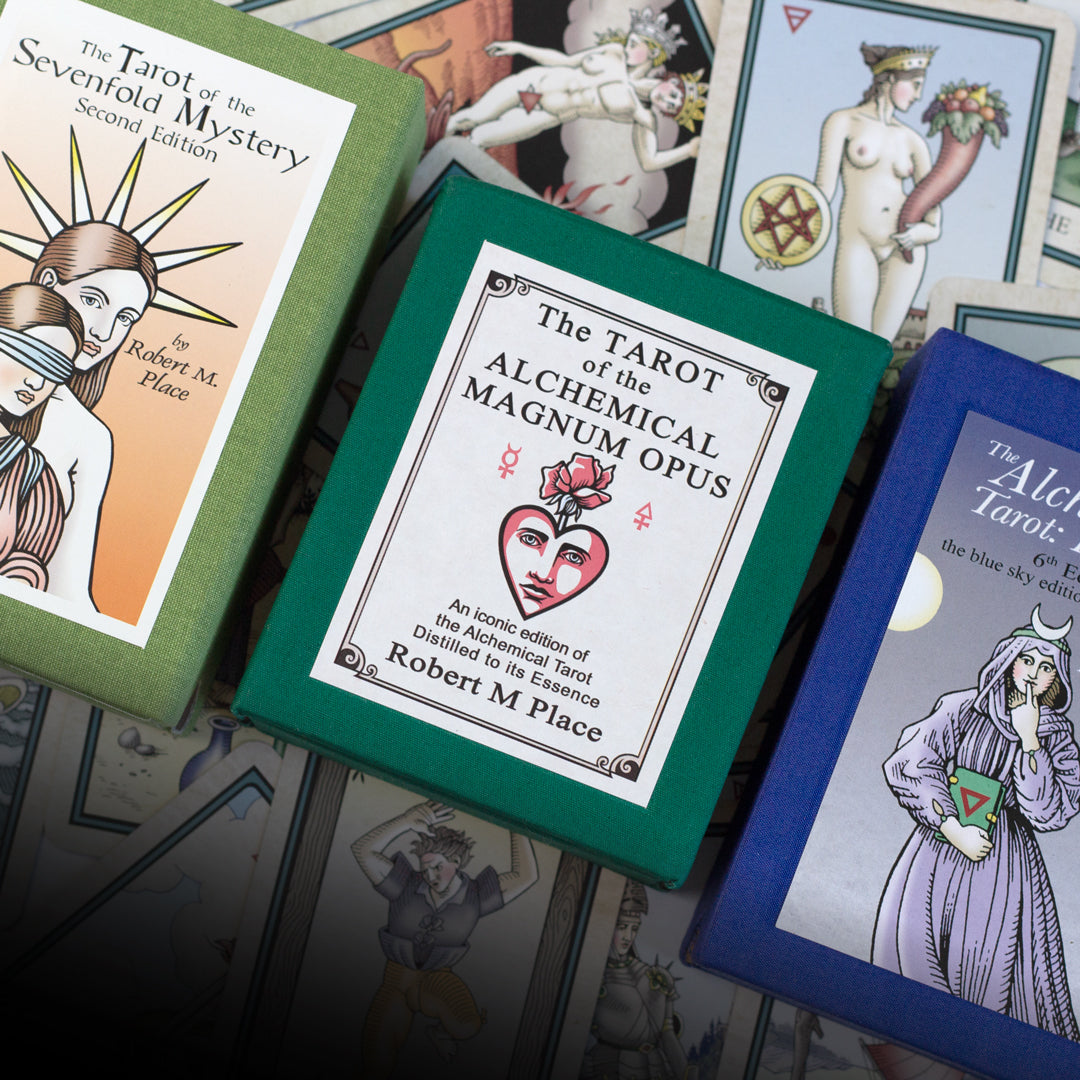
And I absolutely have to bring up the work of Robert M. Place, who, of course, did the Serpent Oracle that we discussed during the episode about oracle decks, but has also created the New York Lenormand, which I just love because it reminds me very much of images you'd see in, like, the New York Times.
But again, because the symbolism is so static across the entire system, you don't see quite as many variations in Lenormand decks as you would in tarot decks. You know how it is, you're looking for a tarot deck, you gotta check, oh, is this based off the Thoth? Is this a Marseille or a Rider-Waite style? Is this doing its own weird thing and adding bonus cards, that sort of thing? That happens a lot less frequently with Lenormand cards.
So really just buy the one that has the nicest art. And by nicest art, I mean it's always gonna be subjective, but you know how I am. I like to collect. So you're gonna want to get a couple with a few little different ways that they express the artwork. But really, you just want to start with one, right? Just to get yourself familiar with the system, play around with it for a bit. You don't have to spend a whole ton of money, which is fine because a lot of Lenormand decks out there also tend to be less expensive than the tarot equivalents. I mean, I'm looking at Artisan Tarot's website right now, www.artisantarot.com, and I'm seeing that the most expensive deck of Lenormand cards they have right now is the Green Glyphs Lenormand, and that's 40 bucks, and that's still a mid-range tarot deck price right there, and that's a high-end Lenormand.
I suppose it makes sense that a smaller deck with 36 cards as opposed to 78 would be less expensive, yes. But bottom line, the Lenormand system is definitely one that's worth taking a look at and playing around with. It's easily the best and most popular divination system named after the person who inspired it. Which, fun fact, she was a medium as well. So, if her beliefs are true, I hope she heard this episode and enjoyed it.
Closing and where to find us
This has been The Art of Divination Podcast, presented by Artisan Tarot, publishers of both historical and modern tarot and Lenormand decks, and your one-stop shop for all things metaphysical. Look for many of the items we discussed today at www.artisantarot.com.
As for myself, I've been Z. Mann Zilla, and you can find more about me at www.Pandangit.com. I wish all of you the best of luck on your own divination journeys. Happy reading, and thank you for your time.