You don't have to memorize everything
There's a popular understanding that one thing that makes a quote-unquote professional tarot reader more professional is that they don't have to look things up all the time. And for the record, that's not entirely true, but I confess it does add a lot of gravitas to your practice when you're not constantly having to look things up in a book. And one way to avoid this is memorization, but I prefer another method: intuitive reading. Still some memorization involved, but a lot less of it.
So that's what we're going to be talking about today. I'm going to introduce you to three very simple intuitive reading techniques and then show you how to put those together. So sit back, relax, and join us as we explore the art of divination.
Looking things up is fine
Welcome to The Art of Divination Podcast presented by Artisan Tarot. I'm your host, Z. Mann Zilla.
On this episode, we'll be discussing intuitive reading. Now, before we dive right into that topic, I do want to point out there is absolutely nothing wrong with having a guidebook in hand or looking things up in general. And to explain why, I'm going to draw on one of my other experiences, which is that I'm a writer. You might have seen the book I wrote about reading tarot on social media. That's available over at Artisan Tarot. And because my interests are all over the place, I've got a bunch of stuff that I've written on my itch page. We even talked about one last week. Thank You for Reading This Spread.
But I tell you all that to tell you this. I use a lot of 50-cent words, and I have many of them memorized, and I am pretty sure I know how they work, but I don't always exactly know. And other times I feel like I might not know exactly how to spell the word that I'm trying to say.
So I still look them up. I grab a dictionary. My favorite being the Merriam-Webster, which gives me every possible definition for the word to make sure that I'm using the word right, lets me know how it's spelled, and even some alternate spellings that are used in other systems, such as, you know, British English versus American English. There'll even be a pronunciation guide just in case I'm saying a word wrong.
And there are words I've used dozens of times that I still look up just to make sure that it's the best word for what it is I'm trying to say. And that the word actually says what I mean it to say. Tarot guidebooks are no different. They provide this clarity so that you can make sure that what it is that's being said is being said as clearly as it possibly can.
And if you're not a big reader, that's fine. Keywords are also provided in a lot of guidebooks as a shortcut for this process, and they work very well. In fact, there's a lot of great decks out there that even put the keywords on the cards themselves to, you know, shortcut that process even more.
Why read intuitively?
So if looking things up isn't really a problem, then why am I talking about this today? Why are we talking about intuitive reading as an alternative to all that? Well, the main one would be that another observation that a lot of folks have when they're attending a tarot reading that's, you know, put on by somebody that's been doing it for a while, or they're watching people doing these tarot readings and just seem to be firing off that information. There's a level of confidence and gravitas that comes with giving a reading quicker because you just have all of that information already in your head. It adds an air of authority to what it is you're saying. That speed is also a benefit if, like me, you're the kind of person that easily gets, you know, a little impatient.
Hemming and hawing over a partially understood meaning, you know, it drags the pace of the reading down. Also, if you're like me, a little bit of attention deficit will kind of fill in a little bit, and you'll start to maybe forget aspects of the original question or where your thread of thinking was going as you were interpreting.
So the faster you can get that information and those answers into your head, the better. But memorizing the meanings and keywords of 78 cards is, you know, a lot to do, especially because afterwards you also have to go through those memories to try to get to the right ones. That's one of the benefits of intuitive reading. Intuitive reading is the act of trusting yourself with a few basic pieces of information as well as your ability to interpret things, specifically abstract things like art or what something reminds you of.
But you use this much smaller, much easier list of knowns as your pick list to draw from, and that gets you the answers you're looking for a lot quicker. So being able to deliver a lot of information that can contribute to your reading in a very short amount of time and giving you enough space to be inspired in the moment.
Where these techniques come from
Now, a lot of the intuitive techniques I'm going to go over are things that I've gleaned from folks such as Dr. Jeremy Weiss over at the Temple of Miriam and William Rader over at Artisan Tarot. They've both given some really great lectures on what they like to call tarot in under two hours, kind of courses that they offer. And you can actually find a Learning the Marseille in Under Two Hours course over at www.artisantarot.com. And I'm still gonna recommend that one because that one's gonna go a lot more in depth into the actual process of reading tarot.
So especially if you're new at reading tarot and you're looking for some great on-ramps there, I would still recommend those courses. But what we're gonna be going over today is gonna be helpful to you regardless of what system you read with. Although it will help if that system has numbers in it.
Technique one: numbers
And this one shouldn't be too much of a hard sell. I'm sure we all have some associations with numbers that just occur to us immediately when we hear the number. Triskaidekaphobia is a fear of the number 13. So obviously, when people hear the number 13, there are some automatic associations. You can almost instantly spot who is familiar with the work of Douglas Adams by simply pointing out the number 42, and you are almost certain to get a reaction out of anybody in Gen Alpha by saying the numbers 6-7, which, if you add two more, you get a funny adult joke.
So numerical associations are everywhere, and nowhere is that more true than in the Minor Arcana of tarot. Each suit of the Minor Arcana contains the numbers 1 through 10, with, you know, one being the ace. Now, if you're on the spiritual side of things, you've almost certainly got some appreciation for sacred numbers, sacred geometry, things of that nature.
And if you're pulling from those systems, then your interpretation of numbers is going to come naturally. But if you're just starting your tarot path or you're trying to remain a secular reader, those numerological associations might not come to you quite as automatically. At least you don't think they would, or many people wouldn't. What I'll say is that once you start hearing some of the more common associations I have, you'll realize that it comes more naturally than you realize. You just have to be open to it.
One, two, and three
For example, a typical meaning of an ace or a one is individuality, referring to the self. Also, as it's the first number, it is a number that signifies beginnings. Oh, and a quick note before we go too much further: I will also mention even numbers are often considered a number of yang energy, whereas odd numbers are considered more yin.
But speaking of dualities, that's often where the association for the number two comes from. Anytime you're dealing with a pairing, such as partnerships or relationships. They also tend to deal with themes of balance or harmony. As a result, the number three often is associated with fertility or creation, because two people create a third together. That's how three becomes a number of fertility or creation or forward progression of a relationship. It's also the number most associated with the Trinity, the Holy Trinity. And so there's also an association that three represents a form of self-completion, and with that creation association, the number three is also often associated with creativity and imagination.
Four, five, and six
Moving on to the number four, this is a number that often occurs to people as one of stability, because when a table has four evenly spaced legs, it is very stable. You can't tip it over from any particular angle without excessive force. This stability also loans it the association of trust. So four often is a number of telling you about strong values or trust.
Of course, the exciting part of most stories is not the part where everything is going nice and well and stable, so four has been perceived to be also kind of a boring number. Moving on to number five, and five, I will confess, is a personal favorite number of mine. I couldn't tell you why; it just is.
But five is often associated with risk because you are moving past the point of stability, and at that point you're not really sure what's going to happen. As such, this is also a number that gets associated with impulsiveness, sexuality, things of that nature. But again, when it's a number that is representing moving on from four, it also represents that assertiveness, trying something for yourself, seeking out more fortune. Oh, and also five senses, so it can also be a number of observation. Six comes after five, therefore representing a resolution to the sort of risks and problems that might be created from a number five type situation. And of course, taking risks, win or lose, means that you are learning some lessons, at least ideally, which is why the number six often is associated with idealism.
You'll notice that a lot of systems often assign the sixes to some sort of a triumph or a resolution that ends in favor of the person making the big risk.
Seven, eight, nine, and ten
From there we move on to seven. Seven is considered a lucky number by many people, and so that association is not at all invalid. However, traditionally the number seven is also associated with mysteries, some sort of a new problem to solve. One of the reasons why is because you know we talked about the odd numbers often representing some sort of a conflict. I like to think of the fives as a conflict where you and others are on equal footing, whereas with a seven, you are dealing from a bit of advantage with your experience and what you've learned from previous risk taking. As such, seven also tends to be a number associated with knowledge and wisdom. Next we have eight, and this is a great number.
In a lot of Eastern cultures, eight is considered the perfect number. And since it comes after the number seven, it also implies a great victory. That association to the number four continues when you consider that if four is basic stability, then eight is being in a position of thriving. Along those same lines, we've got the number nine, which is the number three three times.
So if you're part of a system that considers three a perfect number, three threes is the best thing imaginable, right? So in addition to representing a fulfillment, it also tends to represent complexity or a well-rounded situation. Rare among the odd numbers in that it almost always talks about a favorable outcome. I say almost always. I do find that even if you're doing intuitive reading, the number nine is the one that still has the most wiggle room, and sometimes you gotta think about it for a minute.
But it tends to make a little more sense when you put it in the context of the number 10. I think of the number 10 a lot in the same way I think of The World card. It's the point where you know the progression has ended and a new progression is starting. See, there are very few things in the universe that truly end. When you come to the end of something, you are only coming to the end of that specific thing. Life in the universe goes on regardless. And so often what a 10 represents is a drastic culmination of a situation that leads organically into the start of another one. It's the to be continued at the end of Back to the Future Part II.
Now, I want to clarify that what I've given you are examples. This is by no means an exhaustive list, and this system really works out better if you come up with your own associations. And indeed, you're gonna develop a lot of great associations with numbers just by working with them.
Reading the temperature
Also, in addition to these associations, you have other tools available to you. One of them is a really great technique that Enrique Enriquez came up with called temperature reading, which is just observing how the numbers rise and fall within your spread. If numbers are getting higher going forward, we're seeing forward progress. If we're seeing the numbers going lower, that's backward progress.
And when we talk about temperature, we don't just mean where we are in the story; it can also mean the escalation or de-escalation of important situations within the reading. And if you're like me and you're a bit of a math nerd, there's also lots of numeric associations that can be made. I've had a lot of bigger spreads that have suddenly made perfect sense when I realize that a couple of the numbers in the beginning of the spread add up to one of the numbers in the end, letting me know that what those cards were signifying were key to the results towards the end of the reading.
Technique two: the four elements
But numbers themselves don't always tell you everything you need to know. Sometimes you need to modify the meaning just a little bit, have an external force letting you know specifically what that number is referring to. I mean, I can't just hand you the number six and expect you to know what that means. I could be talking about six chicken nuggets, six degrees Celsius, or six miles away. Good thing there's an even simpler system we can use to try to get some context. It's a topic I go into in much more detail in one of the lectures I've given for Artisan Tarot, which you can find in the membership section.
But essentially, try to imagine a cross, two dividing lines. And on the top and bottom parts, we are measuring what we call foundation and firmament, or earth and heaven, respectively. And on the left and right sides, we have yang and yin, or, you know, masculine and feminine. And to summarize, when we talk about foundation and firmament, we're talking about things of this physical earth versus things of the spiritual realm. And you get a lot more of a benefit on the second half if you have your own understandings of how masculine feminine energy work or how yin and yang work. I can highly suggest doing a bit of a deep dive on those and developing a deeper understanding of them. But in general, yin feminine energy is one of change and metamorphosis, whereas yang or masculine energy is one of stasis or stability.
Earth, water, air, and fire
And a classic way of exemplifying these concepts is to apply them to the four classical elements. So let's start with the foundational elements, the things that represent that of this earth. We have earth, which is your yang version of the foundational. It's a, you know, very stable element; it's why we build houses on it. It's not expected to change much, if at all, versus water, which is the yin equivalent. It's fluid; it's very prone to change, but it's also a thing of this earth; it's a solid thing.
Then we get into the firmament elements, which are air. It's considered sort of the yang element of the air. It's one that deals with, you know, logic and things like that. It's the one that says, well, you're not seeing anything, but there is still something there. And we kind of need air to be there. Without it, we would die. Fire is considered the yin equivalent of the firmament elements because it promotes a lot of change if you really stop to think about it. I guess the shorthand version of that is just because air touches something doesn't mean it's going to change in any way, whereas fire causes great change to just about everything it touches.
The elements in the tarot suits
And you can see those associations in tarot. The Pentacles are the suit that is associated with earth, and therefore it relates mostly to health and wealth. These are considered foundational yang concepts. This is opposed to the Cups, which are your water element, and in addition to dealing with things of emotion, also tend to deal with things of spirituality, but by and large, what we're dealing with are the things that are right there in front of us.
So this is also an association with human relationships, the way we feel about stuff. The Swords are marked as the air element. This is one that talks about intellectuality, making decisions, being pragmatic. That, of course, leaves the Wands, which are commonly associated with fire. And the easy way to remember that is that, you know, a torch is a type of wand or stick, and you use that to set things on fire.
But fire deals with those ephemeral concepts of passion and willpower, things of that nature. Now, again, what I've given you there are the base blocks of helping you sort and compartmentalize those concepts into those four buckets. A lot of times, especially tarot in particular, but a lot of times when you're using a divination tool, there's a way to associate it into one of those four buckets, or the elements of it, I should say, will fit into one of those four buckets. And other associations can be made from there.
The suits and the social classes
For instance, as Dr. Jeremy Weiss has pointed out in his introduction to tarot work, which I will note, by the way, I've been leaning on a lot for the research for this episode. Thank you, Dr. Jeremy Weiss, over at the Temple of Miriam, which you can check out at www.templeofmiriam.com. But one way that these elements used to get sorted was also to associate them with certain classes of people. The Wands, the fire element, were often associated with the serfs or the peasant class. Often this association had to do with the fact that if you get a lot of them together, they can do a lot of damage. And fire is a lot easier to control when it's just a little fire and not a big raging one.
The Cups, with their associations with emotion and spirituality, were often connected with the clergy class. Swords, for both obvious and extended reasons, were associated with the military. I mean, again, swords are a weapon, but also that sort of pragmatism and making swift final decisions is something that's associated with military action. And the Pentacles, with its connection to wealth, was associated with the merchant class. The more you meditate on what these four elements mean to you and what activities you can sort into those buckets, the more quickly this intuitive technique is going to bring some sort of a realization to you in the middle of a reading that will help you out in the moment.
Technique three: interactions
Now, these first two techniques I've introduced to you are very intellectual in a way. They rely on using a formula, putting things together in the moment based on simple little facts. But there's a third technique which, due to it being a lot more abstract, offers a lot more possibilities. Let's talk about it.
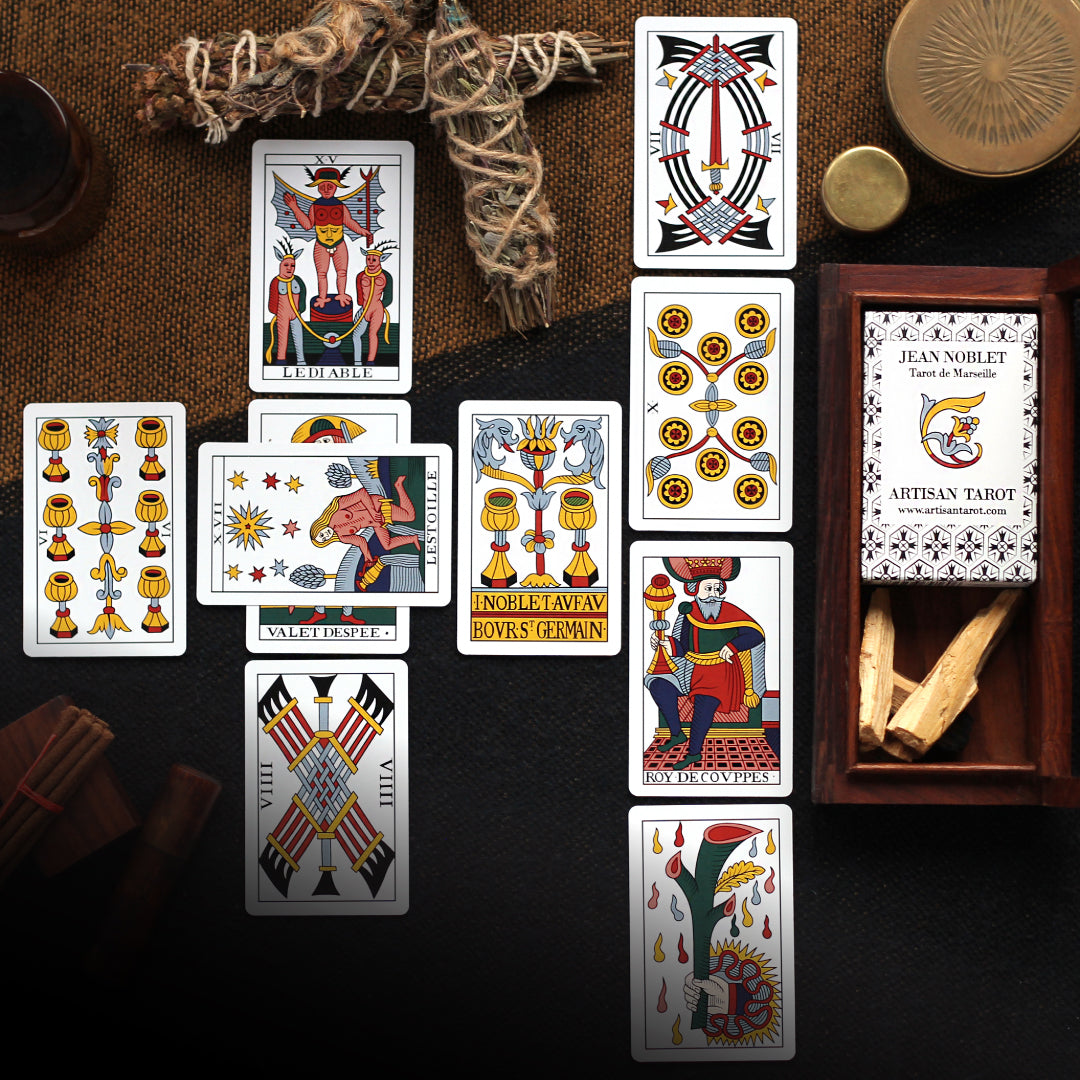
This third technique of intuitive reading is potentially the most powerful because it leaves a lot of room open, not just in the reading you're currently doing, but future readings. And I will confess this one's a lot easier to do when you're using a tool that has a lot of artwork on it. Tarot de Marseille is fantastic for this technique. Rune casting, not so much. And it's also a technique that's discussed heavily in the Introduction to Tarot de Marseille course that is offered over on www.artisantarot.com, and that is interactions. And this is simply observing the way two or more pieces of art interact with one another. As we discussed in the Tarot de Marseille episode, the artwork is simplistic to the point where it's very easy to see the characters sort of looking at one another or even transforming into one another.
For example, it's very easy to pull a spread where The Emperor is to the left of the Death card. And in my deck at least, I use the Jean Noblet reproduction. In that deck, The Emperor and Death are seeing each other eye to eye. If I see this interaction, then what I'm seeing there is regime change or a change in the authority structure.
Reflections and hidden influences
But this need not be restricted to just Tarot de Marseille. I'd happen to be watching a tarot stream from another creator name of PB Undesirables, and they were using something called the Incubus Tarot, which was gorgeous. But one thing I happen to observe during one of their readings was that they had a card that looked like a reflection of the other card when one of the cards was placed in the reverse position.
And when you get reflections like this, this can let you know where a hidden influence is coming from. You might be asking yourself, why are we seeing the Five of Cups in this situation? And then we see another card along the way that looks like a reflection of that Five of Cups, and we go, ah, that's what's going on.
So examining the eye lines of characters, seeing which ones reflect other ones, observing if one of them appears to be transforming into another because of a card that's in between them. These are all little intuitive signs that you can use just from looking at the art to tell a story that you'll never find in any guidebook.
Every part of the reading counts
And remember, every element of the reading is part of the reading. The fact that you're the one doing the reading, the deck that was selected to do the reading, all of these things are part of that reading. And so noticing these little interactions in the art is also a key, vital, unique part of that reading, of that message that you're getting from your randomness, as we discussed in the episode about randomness.
Now, there's only so much I can do in a 30-minute episode of a podcast. I could probably talk about this topic for literally days. But observing interactions is really one of those things that the path you walk is going to be the most important one. Because just like we talked about with building a bone bag for osteomancy or creating your own oracle decks, the symbolism becomes its most powerful when it is coming from you.
And when it is from you, it comes from you a lot more easier every time you revisit it. So, really, the tip to developing this particular skill within you is just to keep doing it as much as possible and at every opportunity.
A sample reading
As for creating those opportunities, let's put everything we've talked about together. Now for this section, I've taken the liberty of doing a five-card draw from the Tarot des Ambiguïtés by Alejandro Rozan. You can find it over at www.artisantarot.com. It's a personal favorite. And the sample question I've pulled is one from a small business owner that wants some advice on the new business that they're starting. We've agreed to a five-card spread, and the five cards I have pulled are the King of Hearts, which is the equivalent of the Cups in this deck, a Nine of Hearts, The Chariot, the Seven of Heads, the equivalent of the Pentacles, and The Tower.
Now it's easy to just look at The Tower and call it a day from there, but this person paid for 20 minutes; they're gonna get 20 minutes. Plus, I'm the kind of person that likes to give more actionable advice, and so as a result, I want to have something that I can actually give them besides, oh, doesn't look good, ill omen.
Reading the spread
So let's break a couple things down with the intuitive techniques we've talked about today. Now, given the context, I believe that the King of Hearts represents the querent. And the presence of the Hearts lets us know that this starting of a business isn't just about just trying to make some money. This is a passion project for them. And the fact that our next card is the Nine of Hearts right after that lets us know that their passion and experience is going to help them set things up flawlessly. All of this is leading into The Chariot.
Now, with a transformation, I have established that the King of Hearts becomes the driver of the chariot in that Chariot card. With the two horse creatures, and again, this is the Tarot des Ambiguïtés, so they have human faces. So this looks to me like, you know, a reference to their staff. It's their staff that's pulling them into success with this business. However, the next card is the Seven of Heads, the Pentacles equivalent, and that leads into the final card, which is The Tower.
So using our numerology, we're looking at a reduction from nine to seven between the numbers, and that reduction is coming from our health and wealth sector. So it's letting us know that some sort of a financial problem on the back end is probably going on. So something about operating costs, more than likely. While every bit of care was taken in the setup, it looks like we're seeing some tripping and falling in the actual war chest afterwards that is needed to keep the business afloat for that two to five years that you need. Perhaps denoting that all of the money went into the setup costs.
What The Tower is really saying
Furthermore, there's a couple things that really make The Tower relevant here. Number one, The Tower also has a crown on top of it, and there's two people falling out of it. So we have two supplicants along with a crowned figure. Furthermore, look at the numbers: Nine of Hearts, Seven of Heads. That totals 16, which is the number of The Tower. I am also observing that while The Chariot's horse creatures are looking to the left in The Chariot pose, in The Tower pose, they are looking to the ground. What I am seeing here is that it's not necessarily a staffing problem. It seems as though the querent has the mind to hire people that share their same passion.
But again, because all of the finances went into the setup costs and nothing was significantly retained for operation, the employees are going to now look to the ground as things get bad. That means that all the motivation in the world is not gonna save your employees if they are just looking to stay on terra firma. They have their own bills to pay, they have their own lives to worry about, and this is not their risk to take.
The advice
So, with this spread in front of me, I would be giving this person the advice that, sure, you should definitely go ahead with this. You've got a mind for most things here, but be mindful of your war chest. You're gonna need enough money to survive for at least five years. Remember, tarot doesn't show the future, it shows a future. You have to make the choices as to whether or not this will be your future.
And in this way, I have given the querent practical, usable advice using only intuitive techniques. So, bottom line, and I'm gonna reinforce this, there's absolutely nothing wrong with looking things up or using keywords or anything like that. But if you really want to expand the possibilities of your craft, definitely consider adding some intuitive techniques to your reading. It's a great way to get so much out of so little.
Closing and where to find us
This has been The Art of Divination Podcast, presented by Artisan Tarot, publishers of both historical and modern tarot decks, and your one-stop shop for all things metaphysical. Look for many of the items we discussed today at www.artisantarot.com. As for myself, I've been Z. Mann Zilla, and you can find more about me at www.Pandangit.com. I wish you all the best of luck on your own divination journeys. Happy reading, and thank you for your time.