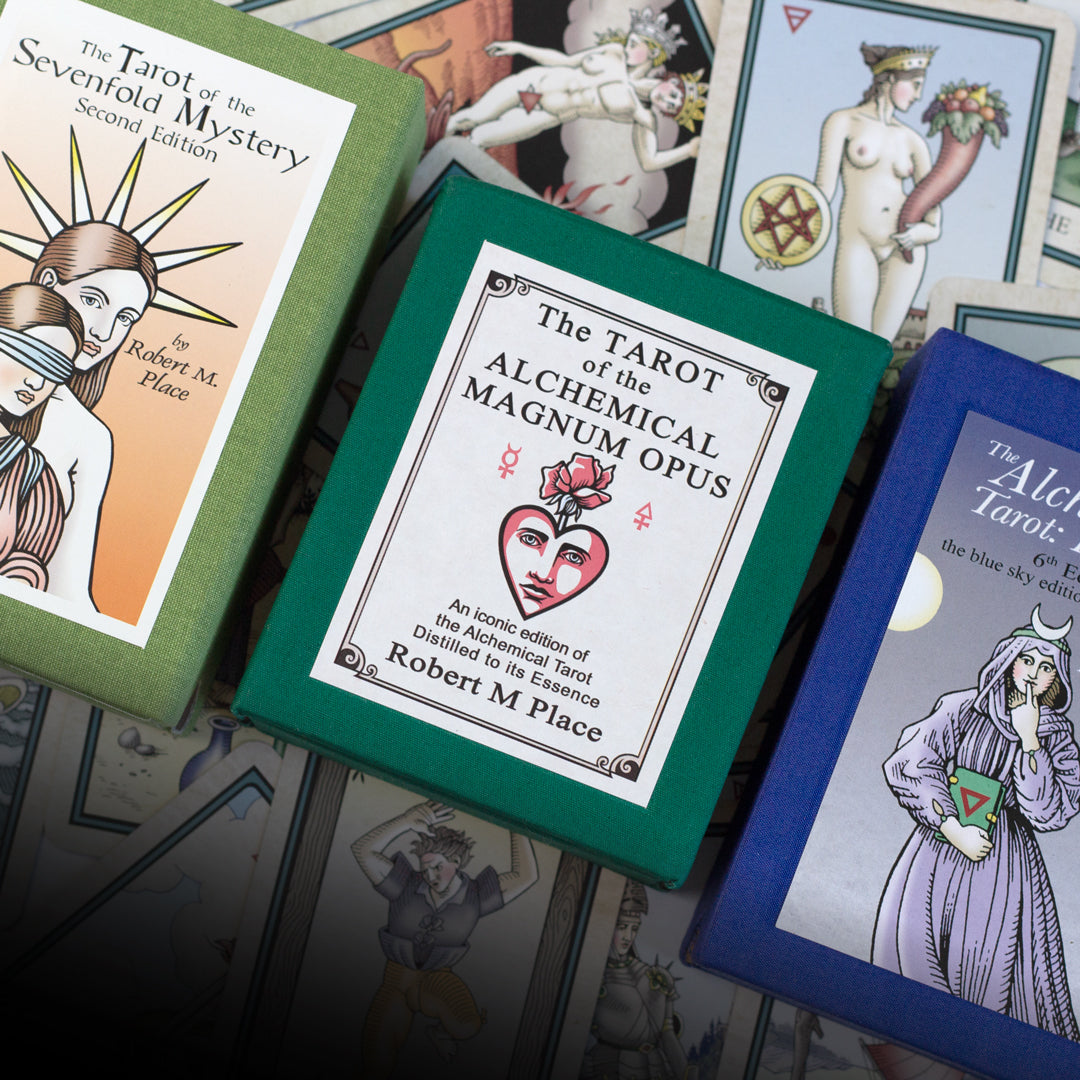


The value of having a large collection
Back when I did content creation for TikTok, I remember responding to a TikTok video that a creator did saying you don't need 20 decks. In my response video to this, I showed off my deck collection, which at the time had about 30 decks in it, and I jokingly referred to it as my emotional support collection.
But the reality is I was only half joking. I feel that there is a lot of value to having a larger collection of tarot decks. So I humbly disagreed then in a short one-minute video, and I'm going to disagree at length in this 30-minute episode of the podcast. So today on The Art of Divination Podcast, we are going to discuss the merits of deck collecting, why we do it, some historical examples of what made this hobby possible, and some reasons you might want to adopt collecting as well. So sit back, relax, and join us as we explore the art of divination.
Why I collect decks
Welcome to The Art of Divination Podcast presented by Artisan Tarot. I'm your host, Z. Mann Zilla.
On this episode, we'll be discussing the merits of collecting tarot decks. Now, at the time of this recording, I've done a brief inventory of all the decks I currently have in my collection, and have placed the number at about 60, which is twice the amount I had back when I was making a spirited defense of having, quote unquote, more than 20 decks.
Now, I've tried to go back and find that old TikTok. Unfortunately, TikTok has made the process of looking for older videos even more difficult than it used to be, if you can imagine that. But I do recall that what I was going for in that video was a more farcical, funny tone. I really just kind of focused on being comically defensive.
But my intent came from a very solid place. You see, for the longest time, I didn't really have the opportunity to collect things at all. Without going into too many details, my life has always been in a constant flux. I've had to move on from a lot of the places I used to live, and these moves had to happen very suddenly. As such, I had picked up a habit, which is that I didn't want to own more than I could easily carry. About 10 years ago, I ended up moving into the apartment complex I live in now, and it took me years, literally years, to finally get comfortable enough to start accumulating things beyond what I could carry in a sudden rush. And so the very act of being able to collect things was itself very cathartic, a sign that I had finally achieved some sort of security.
It was very much a part of my own healing process to be able to be in a position where I could just have stuff. Now, tarot decks aren't my only collection. I also collect pandas, which I'm sure a lot of you already know about, but my tarot deck collection is the largest and the one that I'm the most proud of. And again, I mentioned that I have 60 currently, but that's not even the high amount that I used to have. I've actually had more than that, it's just that many of them have also been given away as gifts.
Each deck suits a different purpose
As for the kinds of tarot decks that I like to collect, you know what? I probably should stop right now because I could probably fill the entire 30 minutes ranting and raving about my cool deck collection. But I'll summarize by saying that the main reason I like having a large collection of tarot cards is because each of them suits a different purpose. And that is important to understanding why somebody might want to collect tarot decks in the first place.
Mamluk cards and the first changes
Because in addition to the macro symbolism of tarot, in which we recognize that, for example, all Swords are of the air suit and discuss intellect, there are also micro meanings that are contained within individual decks. And the adaptation of these card systems to contain these micro meanings is itself pretty old. As we've discussed in previous episodes, there is a popular line of thinking, a myth really, that tarot came from Egypt. And while I've discussed some of my own theories as well as some general theories as to where this idea came from, there is actually a kernel of truth in it. Tarot cards themselves are derived from a European game called Tarocchi, but the design of those cards are in fact based on another game that came out of the Middle East called Mamluk.
These were tall, thin cards that featured elaborate patterns representing their suits, and the cards also featured a lot of abstract designs, and there was some calligraphy on them, often some sort of poetry or saying up at the top of the cards. And they also contained cards that functioned as royals, although because this is speculation here, but it's believed that a religious prohibition on depicting people's faces in Sunni Islam, because of that, the royal cards didn't actually have any pictures of people's faces on them.
And as the cards made their way into European cultures, in some cases as early as the 1300s, this prohibition didn't exist. And so, for example, the royals could depict actual royal figures. In fact, as card games made their way through society, many upper-class and noble folks and families often would commission decks that had their own family members in the royals' places.
Tarot Nouveau
Another change that was made was to the suits themselves. So, for example, Mamluk had a suit of polo sticks, but at the time, polo wasn't exactly a popular game amongst folks that were playing card games in Europe, so that suit was changed to the batons. And this wasn't even the last time changes would be made to the suits.
In fact, the suits that we're familiar with in poker now, the clubs, the spades, the hearts, the diamonds, those are actually part of what we call the Tarot Nouveau suits. And it was a way of further abstracting and simplifying the symbolism for these card games, making them easier to read on the cards as you're playing. And indeed, many modern decks for playing the game of French tarot still use those Tarot Nouveau suits.
And when you look at the trump cards, you know, what we call the Major Arcana, they still depict characters and scenes, but it's very different now from what we're used to when we look at the Major Arcana of the tarot. And indeed, a lot of the changes that were made to create Tarot Nouveau for gameplay, which happened around 1900, a lot of that was to separate the Tarot Nouveau from the symbolism of the Tarot de Marseille, which at the time started becoming more and more associated with the divination arts.
Etteilla's Egyptian deck
Which isn't to say there weren't changes to these cards being made for fortune-telling purposes. One of the first examples, in fact, the first example, would be Etteilla's Egyptian deck. These were cards introduced somewhere around 1789 and were designed specifically for fortune-telling. Now, because Etteilla subscribed to the theories of Court de Gébelin, that the tarot came from Egypt, which you'll remember we discussed in a previous episode, the imagery on his cards was all Egyptian-themed, which itself was a departure from what a lot of the playing cards at the time were doing. The Tarot de Marseille, you know, used royal figures and religious figures familiar to Europeans at the time.
This deck, heavily influenced again by the work of Court de Gébelin, had a lot of Egyptian characters and Egyptian scenarios on the cards. And this was very specifically to make sure that it was known if you are using these cards, it is for the purposes that we've written down here to do divination with the tarot cards.
So, divination with the use of tarot cards can use literally any 78-card deck that's designed for the purpose. And heck, it doesn't even have to be 78 cards. There can be cards that are added, taken away. It doesn't matter. There's a core symbolism to a lot of tarot cards that applies no matter what deck of cards you're using. And yet, individual creators still feel a need to impart some additional symbolism to add just a little bit of gravitas and symbolism that they understand to the decks that they create.
Decks work like fonts
And if this seems like a splitting hairs distinction to you, I'd like to bring up another area of interest that I have, another collection that I have, in fact, that I think will add a little bit of context to all of this. It's the only collection I ever started collecting before I started collecting things, because it essentially doesn't take up any space.
Well, at least not in the physical world. When I was in high school, I got involved with the school newspaper, mostly because they got to sit in a room and play with a computer most of the day. But getting to work on the school newspaper also introduced me to a new lifelong love, desktop publishing.
And if you know anybody that's into desktop publishing, you know how much we love fonts. If you read something, even the same sentence or the same phrase in different fonts, it lends a different tone, even a different voice in your head. And if you don't believe me, go ahead and type any phrase you please and then read it when it's in Times New Roman, Helvetica, Comic Sans, and Papyrus. The sentence is, of course, conveying the exact same information, but the font is adding a little something to it. Times New Roman makes everything feel a little more official, like news even. That same phrase, when typed in Helvetica, takes on a more Art Deco, almost snooty sort of tone.
And then Comic Sans comes along and turns everything into a goofy clown show. Then go ahead and put everything into Papyrus, and everything now sounds like Etteilla himself wrote it. And maybe it's just me, but when you convert a sentence into Courier New, it reads to me like a robot voice. But see, with that change of tone comes a change of context. The way that the thoughts and the ideas in your brain are cataloged and sorted has to do with their close relation to other concepts. Sometimes a piece of information can even cause you to react to it in different ways depending on how it is presented. And one of the subtlest forms of presentation that we have in the written word is fonts.
The same spread in different decks
So when I'm explaining to people why having a lot of tarot decks on hand is very handy, I often draw on my experience doing desktop publishing and graphic design and explain that it works exactly like fonts. As an experiment, go ahead and get a test question from wherever, and then go ahead and answer it with a three-card spread coming from your favorite deck. Next, go ahead and have a look at that same spread in the classic Rider-Waite-Smith cards, and then another one as it is interpreted by the Tarot de Marseille. From there, go ahead and lay out that same spread in one of your more fun, fanciful tarot decks, like perhaps the Mystical Medleys or This Might Hurt or the Tarot of the Woodland Wardens, all of which have varying degrees of art style, the way that they're laid out, you know, even, ironically, the fonts that are on the cards themselves.
And then notice how the same information that you would get from them is colored by the art and the presentation of these individual types of cards.
Setting the tone
And this shaping of tone can be useful in many ways. I find, for example, that theme decks are a great way to introduce folks to the divination arts, someone who might not respond well to the traditional Rider-Waite-Smith or even some of the contemporary decks that are of a more mystical state, like say The Sion Tarot. If the deck has a theme that they're familiar with, say, like I have my Fallout Tarot deck or my Golden Girls theme tarot deck, using one of those gives them some symbolism that they're familiar with, and that becomes a better on-ramp. Decks like the Hermetic Tarot or the Tarot des Ambiguïtés tend to add a lot of gravitas to the reading and give that mystic edge that can really help you out when you're talking with a true believer.
On the other hand, if you're reading at a party for tips and you're just looking to have a little fun, it's nice to be able to whip out something like the Cat Tarot or the Food Fortunes deck. You know, it keeps the tone lighter and makes things more accessible.
Letting the querent choose
So setting that tone is important, but that's not the only reason you would want a bunch of other decks. As I've often said, the reader is just as much a part of the reading as the cards. But the cards are still part of the reading. But what if you could shuffle decks? Not just one deck, but many. And here's where I pull the curtain back a little bit and explain to you what it is I'm actually doing when I'm matching energies with somebody. On a higher level, I like to believe that the querent needs to be in some way taking responsibility for the fortune that's about to be told. They must invest something in it, because if all they're doing is just throwing some information at you and expecting you to make a show out of it, that puts all the onus on you.
There's nothing for them on their side of things that makes them need to retain it or be part of it or anything. In that situation, you may just as well be a television or a book. So I like to have an element that they are a part of, but it goes a little beyond that as well, because it also adds an extra layer of fascination to events when you, as the reader, don't have complete control over what cards come up. We talked a bit about this during the randomness without cards episode, and I'm going to expand on that just slightly here.
Generally speaking, the more elements that are outside of your control, the more impressive your results. And if you're of a spiritual nature, it's also more opportunities for the universe to step in and shape the message that your tool is giving you. And so when you are matching energies with your querent, what you are doing is you are giving them opportunities to further randomize the reading. And one of my favorite ways to do that is to present multiple decks that the querent can choose from and allow them to pick the deck that we're gonna read with.
Now, in my head, this is really neat because every use of the deck also means that you are shuffling it for the next person being read for. So it's also sort of a chain of community that's happening there. But on a more personal and individual level, it represents one other thing that is outside of your control. You didn't choose to use that deck before the reading. They did. And so there is a degree of responsibility on them for the cards that are about to come up.
This incidentally is the same reason you would have them cut the deck at some point during the reading. It's the same principle. So, functionally speaking, it's very important, I feel at least, to have a variety of decks that the querent can choose.
Choice as self-expression
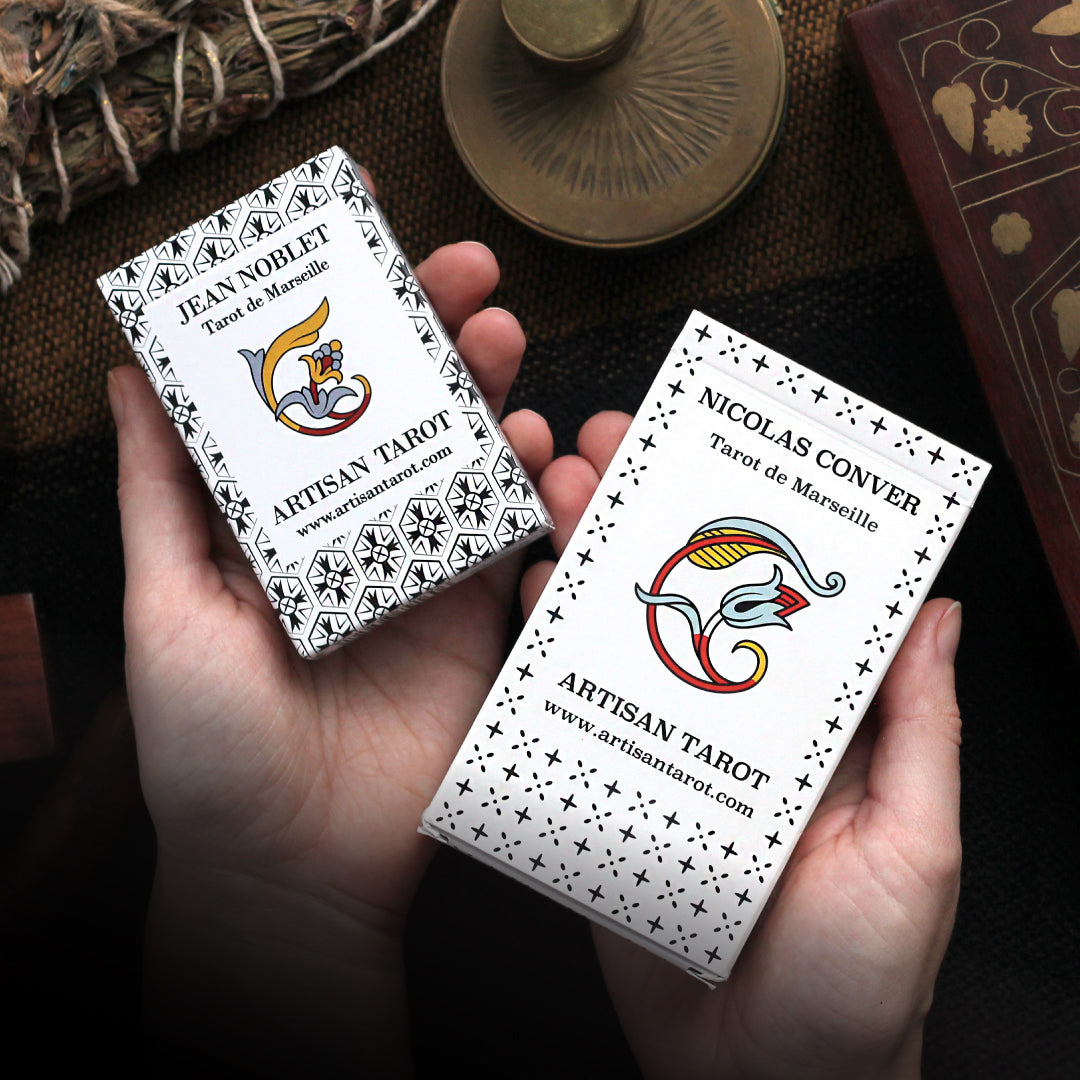
But that sharing of energies goes beyond just a simple pick which deck we're gonna use. It also offers the querent an avenue of self-expression. A querent may look at the decks that I've made available to them and decide, oh, I'm looking for a more serious reading. So, we're gonna go with the Conver Tarot de Marseille. Or perhaps they peruse my entire collection and say, oh, that Tarot of the Vampires looks interesting. I think I'd like a reading from that because I'm really into vampires and goth culture. Or perhaps they're a little stuck on what they want until they happen to notice that I have an Adventure Time tarot deck and go, oh, I'm really into that show, let's go with that. Whatever the reason that one of the decks speaks to your querent is reason enough.
They have exercised their agency, their right to choose, and that choice has now affected the reading. And so one of the great reasons to collect decks is because you end up with more choices to give to your querents. Now that isn't to say that every single deck will be chosen. I still have a few decks in my collection that have never been chosen by a querent. Heck, at least three of the decks in my collection have never even been shuffled.
But I still have them. They represent choices that can be made or not made by the folks I'm reading for. Now the thing is I have to approach this episode with a certain conceit that I'm talking to people who are considering deck collection. They've only got a couple and they're wondering why they would want 10, 20, 30 more.
But chances are, at least some of you, I'm preaching to the choir. So I doubt a lot of this information is going to give you something new to think about. Or perhaps it will at least help you win some arguments with your significant other when you've decided you want a new deck. But if you're not a collector yet and would like to be, then this next section is for you. These are the things I look for when I'm obtaining new tarot decks.
What I look for in a new deck
So, what is it I look for when I'm looking to get a new deck? Because, you know, as I've said, I only have about 60 in my current collection. That's not a particularly huge collection by any stretch of the imagination. There are certainly collectors that have many more decks than I have. Is it because I'm so picky? Partially, but also because tarot decks tend to be a little expensive.
But yeah, I am also a little bit picky. I am looking for particular things for my own collection, and that's really where the first tip comes from.
Get what you like
This is really the golden rule of tarot deck collecting. Get what you like. There are certain things that will make me want to grab a deck immediately. If it's Eastern philosophy themed, if it has pandas on it, if it's based on a pop culture franchise that I'm really into. Those are all automatic want.
Now, that isn't to say that I'm 100% happy with all those purchases. In fact, most of the panda decks I've bought, despite the fact that I collect panda stuff, have been given away as gifts. And by and large, it's not the fault of the panda decks themselves. It's just that I got my hands on The Way of the Panda Tarot by Kimberly M. Tsan and Celia Libelle, which I feel is the only panda deck I need in my life. The other ones were given as gifts, and because they have pandas on them and come from me, they make an especially poignant gift, which brings me to tip number two. You're not always buying for yourself.
You're not always buying for yourself
There's an old tarot superstition that your first deck must be gifted to you, and while I don't 100% believe that that's true, I think it's a very nice tradition, and I do feel that receiving a tarot deck as a gift does lend it a little bit of power. I believe I've discussed in the past about the concept of provenance, the idea of knowing where an object comes from, particularly a tarot deck. Where the tarot deck comes from is part of the stories that it can tell. So receiving a tarot deck as a gift already gives it a powerful piece of provenance.
Know where the deck came from
And on that note, that's my next tip. You want to get familiar with how the deck got into your hands. That means also familiarizing yourself with the artists and writers who helped create it. This is due in part to the fact that when an artist creates these images, they have specific ideas in mind of what the message of the card is supposed to convey.
This may differ from your own default understanding of the card, and those little changes can be very important to getting the individual idea that is trying to come across in each individual reading, especially if the querent chose that deck over another. Perhaps that unique interpretation of what the card is supposed to mean more readily applies to that reading. It therefore makes that matching of energies so much more meaningful.
Never AI
And of course, that meaning comes from human interpretations, which is why I'm going to take this opportunity to say I will never purchase a deck that has AI in any point of its creation. Firstly, I like to collect decks that can suit at least some sort of purpose. I'm gambling a little bit, obviously, and like I said, there's at least three decks I've never used, but the fact of the matter is that these are all created by humans. They're created with an intent. And it is an intent that is linked in some way or another to the craft, which is a very human craft. AI decks are typically created with the intention of making a lot of money as quickly as possible, and that sort of cynicism is just not something I can abide by in my practice.
Plus, as we discussed in the episode about tarot scams, AI represents another shortcut that can be taken by people who are trying to flip product with as little effort as possible on their part. So keep in mind also, on top of all of the disadvantages of AI, be they personal or general, there's also the social stigma. People are coming to you for, you know, an ancient human craft, or they're coming to you to see how you interpret the cards.
So getting an AI involved in all of that just really makes the whole thing feel artificial. And finally, as we discussed in the episode about giving advice, this is an advice-giving medium. And AI doesn't exactly have a great track record of giving good advice.
Collect with a purpose
And then finally, I believe I touched on this before, but it's a good idea to collect items that suit a purpose. For a while, my collection was being built up around this idea that I was doing tarot deck reviews for TikTok. So there were a lot of decks that I obtained for reading purposes, yes, but there are other ones that I collected simply because I wanted to review them.
Now, it isn't to say that a tarot deck will not go beyond its purpose, but you know it's a good idea to have a reason you want it in the first place. If for no other reason than to be pleasantly surprised.
The deck I didn't like
So we've talked a lot about why you might want a deck, but one thing I do want to bring up is that sometimes things don't follow the rules. For example, I alluded to how I used to collect decks specifically for review purposes. And the funny thing about review content is that your good reviews, you know, they can get some hits and whatnot, but due to the nature of the way social media works, your negative reviews tend to get more play.
And as a result, there was a specific company, I won't mention names here on the podcast, but there was a specific company that I would keep getting these decks from, and they would just consistently be bad by my standards. So it became kind of a thing on my channel that I would make fun of this company. One of the decks that they made was a theme deck based on Alice in Wonderland. And it had a lot of the same problems that I had with other decks that I'd gotten from the company. Everything from the cardstock to the lazy execution of the art, you know, just I wasn't into it.
But then months later I got invited to do readings at an event that was celebrating mushrooms and psilocybin. It wasn't a paid gig, but I would be allowed to set up a tip jar. And furthermore, my table was really out of the way. People basically had to be wandering around aimlessly to discover me. Not an ideal situation by any stretch of the imagination, and yet I walked out of that festival with the biggest payday I had ever gotten. All off the power of the single deck, the Alice in Wonderland deck. Every single person requested it, even though I had brought 12 decks with me. Every single person that got a reading loved their reading, and every single person tipped generously.
So despite this Alice in Wonderland deck being everything that I personally didn't like in a deck, it turned out to be the most valuable part of my collection. And it's not really the only example of that. For example, I get a ton of mileage out of my Miss Cleo Tarot Power Deck. It's a deck I largely bought as an ironic joke. And yet I've gotten so much material out of it for my social media practices, and if I'm being entirely honest, it's a fun deck to read. I had a similar experience with my Fallout deck. Again, coming from a company whose creations I'm not a really big fan of, and having a lot of the bad habits that I don't like in gimmick decks.
But people requested the deck over and over again. I had more and more opportunities to read with it, and it was that activity that gave the deck its provenance and its meaning to me and made it easier for me to read. So the moral of that story is you can have all sorts of expectations for the decks that you want to collect. You know, you can seek out specific types of deck that you like, you can love a deck because of the art; you know, you can just thoroughly hate a deck that somebody gave you as a gift. Regardless of the situation, make it part of your collection.
Because not only have I been burned on what are supposedly really good decks that can be very expensive, but then you get the artwork, and it just doesn't speak to you, or, you know, maybe the cards are a texture that just doesn't feel good to you, or maybe they're too big for even your hands. But sometimes you get a so-called bad deck that just changes everything for you.
The indestructible PVC deck
For example, one time I got my hands on a PVC deck out of morbid curiosity that I saw on Amazon for like $15, $20. I can't even remember because the listing isn't even there anymore. But these were plastic cards made out of PVC that were allegedly indestructible. And when I got them, they were just stock art galore and a lot of misprints, bad translations, and all that other stuff. The cards you can bend right over and they don't destroy, which is great. They're completely waterproof.
But as tarot cards, they're kind of terrible. And yet I love this deck. First off, because shuffling it, because they're bigger, heavier cards, makes them feel like you're just petting a big orange cat. But the box also has a fun little message in the beginning. You open up the box and you are greeted with the message, let's share the tarot world happily. It's why I love these cards, it's why I read with these cards. It's also why I give cards as gifts. Great things can come from even the most unexpected of places.
Let's share the tarot world happily
And that right there is the main reason I love collecting tarot decks. There are just so many ways that they express themselves, so many messages that they can give, so many new and exciting possibilities with each one I get. So, let's be tarot collectors. Let's research Kickstarter and Etsy sellers to make sure that what we're getting is legit.
Let's spend a day off rearranging our shelf to try and re-sort everything because we just got a deck that changes everything about our current sorting system. Let's receive a deck that we already got as a gift, so now we have doubles, so we take the original and give that as a gift to somebody else.
Let's descend like sharks on every single blemish sale that we see. Let's share our new acquisitions with the Discord. Most importantly, let's share the tarot world happily.
Closing and where to find us
This has been The Art of Divination Podcast, presented by Artisan Tarot, publishers of both historical and modern tarot decks, and your one-stop shop for all things metaphysical. Look for many of the items we've discussed today at www.artisantarot.com.
As for myself, I've been Z. Mann Zilla, and you can find more about me at www.Pandangit.com. I wish you all the best of luck on your own divination journeys. Happy reading, and thank you for your time.